Colours & coat patterns
Black Shih Tzus and every other colour, honestly
Six colours have gone home with Singapore families from our shop, solid black included. Here is what each one means, what fades, and why the price never changes, from Curious Tails, an AVS licensed shop.
Is a black Shih Tzu rare?
Yes. Solid black is one of the rarer Shih Tzu colours, and an adult that stays jet black is rarer still: a common fading gene lightens many black puppies before their first birthday. We place solid black Shih Tzus in Singapore at the same $3,888–$4,888 all-in price as every other colour, with no rare-colour surcharge.
Six colours placed, one honest price, zero surcharges
The straight answer on black Shih Tzus
A black Shih Tzu is a Shih Tzu whose coat and pigment are fully black: the nose, lips and eye rims all carry black pigment, not just the hair. Solid black means no white blaze, no gold shading, black through and through. Of the six colours we place at our Shih Tzu specialist shop in Singapore, solid black is the one buyers ask about most and see least.
Rarity is real, but it is not magic. Black is simply less common in litters than gold and white combinations, and many black puppies do not remain black, which is the part most listings leave out.
Black Shih Tzu, at a glance
- Solid black: coat plus black nose, lips, eye rims
- One of the rarer colours in the breed
- Many black puppies lighten or silver with age
- Black points stay black even if the coat fades
- Same all-in price as every other colour we place
Will a black puppy stay black? The fading gene
Coat fading in Shih Tzus involves inherited colour genes, and it is common in the breed. A puppy carrying the fading trait starts lightening as early as four weeks old, and the coat usually settles into its adult colour around the first birthday. A separate silvering trait can turn a black coat a rich steel grey instead.
Singapore adds its own twist: strong sun can give a black coat a reddish, sun-burnt tint over time, which is cosmetic, not a health issue. What never changes are the black points. The nose, lips and eye rims stay black for life, even on a coat that silvers, as this black Shih Tzu rarity guide explains.
So here is our honest line: nobody can guarantee a black puppy will be a black adult. A seller who promises adult colour is selling you certainty they do not have.
The colour-change timeline
- From ~4 weeks: fading can begin in carrier puppies
- By ~12 months: the adult coat colour has largely settled
- For life: black nose, lips and eye rims stay black
- Ongoing: strong sun can redden a dark coat slightly
Every colour we actually place
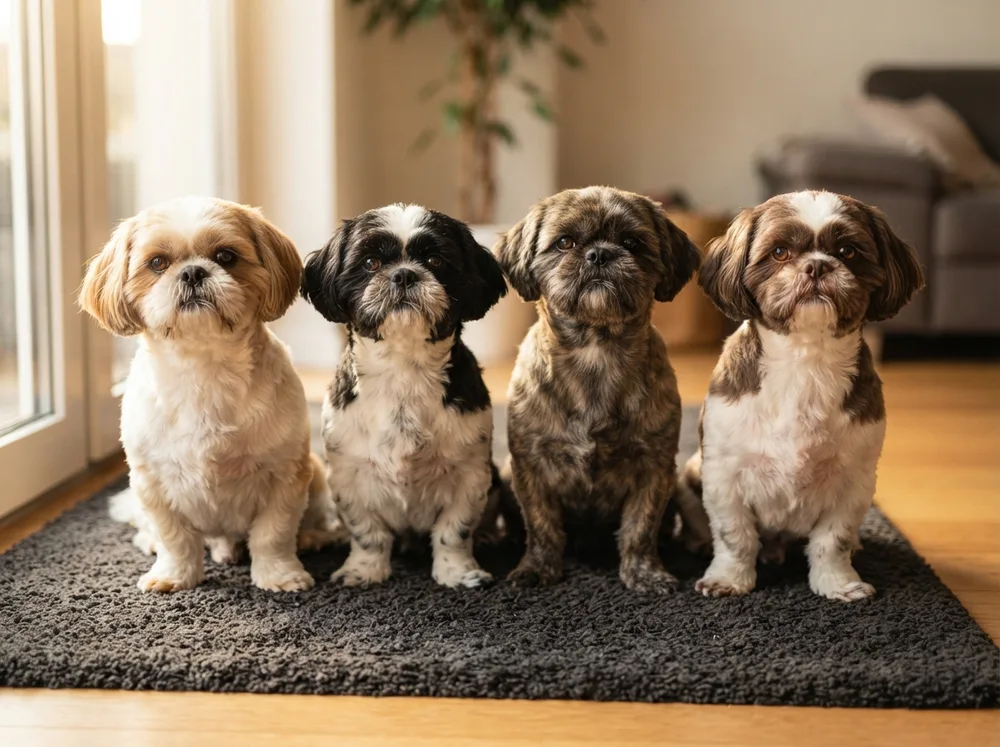
Six colours have gone home with Singapore families from our shop: gold & white, black & white, brindle, liver (including liver & white), red & white, and solid black. That is the owner-confirmed list behind our 30+ placements, not a copied breed chart. Litter mix varies, so which of the six are available in a given month changes.
Gold and white is the classic look people picture, the warm two-tone coat with a white blaze. Black and white is the tuxedo of the breed and far more common than solid black. Red and white runs deeper and warmer than gold, sometimes close to mahogany as a puppy.
Placed by us, colour by colour
- Gold & white: the classic warm two-tone
- Black & white: the common tuxedo coat
- Brindle: streaked pattern over a base colour
- Liver / liver & white: brown pigment line
- Red & white: deeper and richer than gold
- Solid black: the rare one, fading caveats apply
The full Shih Tzu colour chart
The breed's palette is wider than any one shop's litters. Kennel clubs recognise solid colours, dual combinations and patterns, and a colour and pattern guide will list well over a dozen. Here is the honest map of what each family of colours means.
| Colour / pattern | What it actually means | How common |
|---|---|---|
| Solid black | Black coat with black nose, lips, eye rims | Rare; often fades or silvers |
| Black & white | Black body with white markings | Common |
| Gold / gold & white | Warm honey tones, usually with white | The classic, most seen |
| Red / red & white | Deeper, richer red than gold | Less common than gold |
| Brindle | A pattern: streaks over a base colour, not a colour itself | Uncommon; can soften with age |
| Liver | Brown pigment: brown nose, lips, eye rims; coat light to chocolate | Uncommon; recessive from both parents |
| Blue / silver | Diluted black pigment, steel-grey tones | Rare |
| White | Mostly white coat from strong dilution | Uncommon as a near-solid |
Brindle and liver, properly explained
Brindle trips people up because it is a pattern, not a colour: darker streaks running through a lighter base, a little tiger-striped, and no two brindle Shih Tzus wear it the same way. Some brindle puppies soften dramatically by adulthood, another reason to fall for the dog rather than the finish.
Liver is the other misunderstood word. It names the pigment, not the coat shade: a liver Shih Tzu has a brown nose, brown lips and brown eye rims, and often lighter, amber-toned eyes. The coat itself can be anything from pale cream to deep chocolate. It is a recessive trait, so a puppy needs the gene from both parents, which is why liver litters are the exception, not the rule.
Fall for the dog, not the finish. The coat will change; the temperament is what you live with.
Does colour change the price? No.
Every colour we place is $3,888–$4,888 all-in, solid black included. A "rare colour" surcharge is a pricing story, not a quality signal, and we treat it exactly the way we treat the mini and teacup myth: we refuse to sell on the label.
When you see a listing charging a premium for black or liver, ask what the premium buys. It is the same breed, the same vet check, the same grooming bill. Colour hype is also a favourite lever of unlicensed sellers, which is where the real risk sits.
$3,888
From, all-in, any colour
6
Colours placed by us
30+
Shih Tzus placed
$0
Rare-colour surcharge
Colour and life in Singapore: heat, sun, stains
Colour does change a few practical things in this climate. A dark coat absorbs more heat, and on a flat-faced breed that already handles heat poorly, that means a black Shih Tzu earns early-morning and evening walks even more strictly than a gold one. Our honest Shih Tzu health guide covers the flat-face heat rules in full.
Sun is the second factor: months of strong UV can tint a black coat reddish. The third is cosmetic and belongs to the light coats: tear staining shows plainly on white and gold faces and barely at all on dark ones. None of these should pick your puppy for you, but you should know them before the photos do the choosing.
Singapore colour realities
- Dark coats: stricter off-peak walk timing in the heat
- Strong sun can redden black coats over time
- Tear stains show most on white and gold faces
- The puppy cut is the practical cut in this climate
- Every colour: same daily brushing, same groom cadence
Grooming by colour: what actually differs
Almost nothing, and that is the point. Hair, not fur, means every Shih Tzu colour gets daily brushing and a professional groom every four to six weeks, at about $75 to $120 a session, roughly $900 to $1,400 a year. The colour decides only the small stuff, and the honest numbers live in the real grooming cost guide.
| Coat | Extra attention |
|---|---|
| White / gold & white | Daily face wipes; tear-stain management around the eyes |
| Solid black / black & white | Sun exposure watch; heat-timed walks; dust shows readily |
| Brindle | None extra; enjoy the pattern while it lasts |
| Liver / liver & white | None extra; protect the lighter nose from harsh sun |
| Every colour | Daily brush, groom every 4–6 weeks, top-knot or puppy cut |
Which colour should you choose?
Here is the matching logic we actually use in the shop. If your heart is set on a dog that stays jet black, temper the expectation, because fading is common and nobody honest guarantees adult colour. If daily face-wiping would annoy you, a darker face hides stains better. If you want the classic Shih Tzu of the photographs, gold and white is the one.
And the practitioner's note we give every buyer: we qualify families on grooming-readiness, not colour taste. A Shih Tzu is a daily brush and a groomer on retainer for over a decade in any colour. Pick health and temperament first, then tell us the colour you love and we will tell you honestly when we expect to place it.
Colour myths, retired
- Colour has no effect on temperament; a black Shih Tzu is not less friendly
- A rare-colour premium is marketing, not quality
- No seller can guarantee an adult coat colour
- Owner forums are full of "my black puppy turned silver" surprises; that is normal, not a defect
Buying a rare colour safely in Singapore
Rare-colour hype is a known lure in unlicensed listings, and buying wrong is expensive twice: sick smuggled puppies can cost $5,000 to $10,000 in vet bills, and one Singapore buyer was fined $7,000 for buying a smuggled dog. Whatever the colour, check the seller before the coat.
Any legitimate shop appears on the AVS public registry of licensed pet shops; our licence is AS24J00046. Every puppy we place, black or otherwise, goes home vet-checked, vaccinated, microchipped, with breed identification, and HDB-legal.
The colour-shopping safety check
- Seller on the AVS public registry: non-negotiable
- Rare-colour surcharge: treat as a red flag
- Ask to see the parents and their colours
- Vet check, vaccination records, microchip: standard
- Adult-colour "guarantees": walk away
What colours are available right now?
Litter mix varies month to month, so the honest answer is: message us. Across 30+ placements the six colours above have all gone home, and we will tell you plainly which are here now, which are expected, and what fading we would predict for each puppy, or you can see the puppies currently available first.
One thing before the colour talk: a Shih Tzu needs daily brushing and a $75 to $120 groom every 4 to 6 weeks, about $900 to $1,400 a year. Ready for that? Then let's find your colour.
6
Colours placed
4–6 wks
Groom cadence, any colour
45
Five-star Google reviews
HDB ✓
Approved, item 48
Keep exploring before you choose
Frequently asked questions
Are black Shih Tzus rare?
Yes. Solid black is one of the rarer Shih Tzu colours, and an adult that stays jet black is rarer still because a common fading gene lightens many black puppies. We place solid black at the same all-in price as every other colour.
Do black Shih Tzu puppies stay black?
Not always. Fading can start from about four weeks old and the coat usually settles near the first birthday; some black coats silver instead. The black points on the nose, lips and eye rims stay black for life.
Is a black Shih Tzu more expensive in Singapore?
Not from us. Every colour we place is $3,888 to $4,888 all-in. A rare-colour surcharge is a marketing device, and we refuse it the same way we refuse mini and teacup labels.
What does a liver Shih Tzu mean?
Liver describes pigment, not just coat shade: the nose, lips and eye rims are brown instead of black, often with lighter amber eyes. It is a recessive trait a puppy needs from both parents, and the coat can range from light cream to deep chocolate.
What colours do Shih Tzus come in?
The breed spans solid colours (black, white, gold, red, liver, blue, silver), dual combinations like black & white and gold & white, and patterns like brindle. We place gold & white, black & white, brindle, liver, red & white and solid black.
Which Shih Tzu colour is best?
None, honestly. Colour has no effect on temperament, and every coat needs the same daily brushing and a groom every 4 to 6 weeks. Choose on health and temperament first, then ask us which colours are currently available.
Meet your Shih Tzu
Come say hello at Balestier
2 Balestier Road #01-701, Singapore 320002 · Weekdays 12pm–6pm · Weekends 10am–6pm. Or message us first: tell us about your home and routine, and we'll tell you honestly if a Shih Tzu fits.
Set on a colour we do not have yet?
Tell us the colour you love and we will tell you honestly when we expect to place it, and what fading to expect.
Read the grooming reality first