Breed comparison
Shih Tzu vs Bichon Frise: the honest Singapore comparison
Two HDB-approved, low-shedding, grooming-heavy companions; one honest tiebreaker. We place Shih Tzus at Curious Tails, and when the Bichon is the better fit for your flat, we will say so.
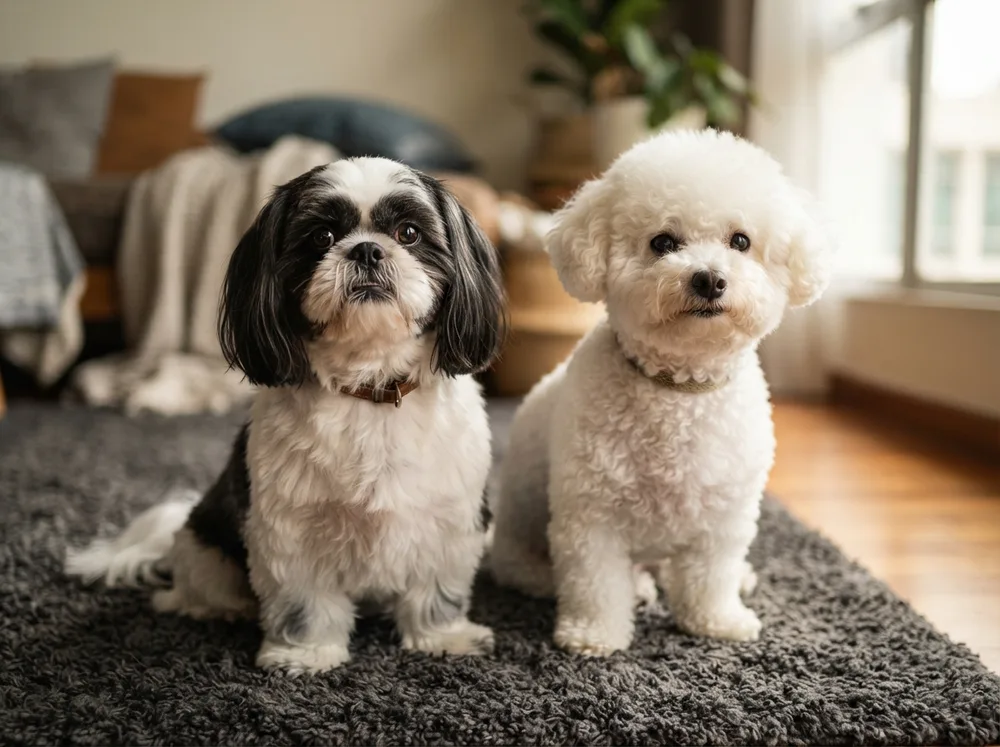
Shih Tzu vs Bichon Frise: which should you choose?
Both are HDB-approved, low-shedding companion breeds that need daily brushing and a $75 to $120 professional groom every 4 to 6 weeks. Choose the Shih Tzu if you want a calmer, sturdier lapdog and can manage its flat face in Singapore's heat; choose the Bichon Frise if your home is livelier and you can meet a bouncier dog's exercise needs. The grooming bill is the same either way.
Two flat-legal companions, weighed honestly
The two breeds at a glance
The Shih Tzu and the Bichon Frise are both toy-sized companion breeds bred purely to live with people, which is exactly why cross-shopping them is so common. Each is a small dog breed of roughly 4 to 7.5 kg, under 30 cm, with a low-shedding, high-maintenance coat of hair, not fur. The practical difference between Shih Tzu and Bichon Frise ownership sits in the muzzle, the coat texture, and the energy level, and those three things should decide it.
The Shih Tzu, the "lion dog" (獅子狗), wears a long flowing coat (a straight double coat) over a sturdy, low-slung frame and a flat face. The Bichon carries a curly powder puff coat on a squarer, springier build with a longer muzzle. PDSA's Shih Tzu breed guidance puts the Shih Tzu's lifespan at 10 to 16 years; the Bichon is often quoted at around 14 to 15.
Side by side, at a glance
- Weight: both about 4 to 7.5 kg, under 30 cm
- Coat: straight double coat vs curly powder puff
- Muzzle: flat face vs longer muzzle
- Lifespan: 10 to 16 years vs about 14 to 15
- Energy: calm lapdog vs bouncy playmate
- HDB: both on the approved small-breed list
What they share, and why the choice is hard
Every attribute that matters for flat living overlaps: both breeds are HDB-approved, both are affectionate lapdogs that suit children and elderly owners, and both are marketed as hypoallergenic even though no dog truly is. Their coats shed little because loose strands stay trapped in the hair, which is precisely why daily brushing is non-negotiable for either one.
Search "shih tzu vs bichon frise singapore" and you get global stat tables with zero local context: no grooming prices, no HDB rules, no tropical-heat advice. Every Bichon Frise vs Shih Tzu article online reads like two encyclopedia entries stapled together, so this page sits in the full breed comparison hub as the closest call of the lot, argued to a verdict. You are choosing between two grooming-heavy companions with one big difference in the face and one in the batteries.
Grooming: the bill is the same, the coat is not
Grooming cost is the number no Shih Tzu Bichon comparison publishes, so here it is: in Singapore, a full groom for a small breed runs about $75 to $120 a session for either dog, and both need the salon every 4 to 6 weeks. That is a grooming budget of roughly $900 to $1,400 a year, for the dog's whole life, on top of daily brushing at home. Singapore grooming price surveys confirm the band.
The coats fail differently, though. The Shih Tzu's straight hair mats behind the ears and on the hind legs, needs a top knot to keep hair out of the eyes, and stains under the eyes on light coats. The Bichon's curls trap moisture and matt faster in Singapore humidity, so skipped brushing days cost you sooner. For both, the puppy cut is the practical Singapore answer, and we tell buyers that before we talk price; the first professional groom is included with every puppy we place, because we want the habit started right. Read the real Shih Tzu grooming bill before you commit to either breed.
| Grooming line item | Shih Tzu | Bichon Frise |
|---|---|---|
| Daily brushing | Yes, line brushing to the skin | Yes, curls matt fast if skipped |
| Professional groom | Every 4 to 6 weeks | Every 4 to 6 weeks |
| Cost per session (SG) | $75 to $120 | $75 to $120 |
| Yearly salon total | $900 to $1,400 | $900 to $1,400 |
| Coat trouble spots | Ears, hind legs, tear stains, top knot | Moisture-trapping curls in humidity |
| Practical SG cut | Puppy cut | Puppy cut or teddy bear cut |
Singapore heat: the biggest real difference
The Shih Tzu is brachycephalic: the flat face shortens the airway, which reduces heat tolerance and puts it on the BOAS spectrum described in PDSA's breed guidance. In Singapore's year-round heat, that is not a footnote; it is the single biggest practical difference between these two breeds. The Bichon's longer muzzle simply cools better, and that is an honest point in its favour here.
A Shih Tzu owner designs around the climate rather than fighting it: dawn and dusk walks instead of midday walks, aircon or a fan through the hot hours, and a short practical coat cut. You cannot just "walk him more". Heavy laboured breathing, bright-red gums, or collapse on a warm walk is heat stroke territory, and that is an emergency: cool the dog and get to a vet immediately.
The flat face is a health profile, not a cute feature
Buyers coo at the flat face and ignore what it means. If your household cannot commit to dawn and dusk walks and aircon in the hot hours, the longer-muzzled Bichon is the safer pick, and we will tell you so.
Temperament: calm lion vs bouncy cotton
Temperament is where the two stop looking alike. The Shih Tzu is an easygoing, sturdy lapdog: happy with company, short strolls, and a spot on the sofa, with more spine and character than the delicate toy breeds. The Bichon is the bouncy cotton companion: livelier, more curious, and hungrier for play and mental stimulation.
Both are genuinely good with children and elderly owners, which is why both make the shortlist for multi-generation flats. Owners on r/shihtzu commonly describe their dogs as "stubborn charm on four legs", content to nap while you work; Bichon owners more often report a velcro dog that invents games when bored. Neither is a watchdog beyond alert-barking at the door, but boredom in the livelier breed leaks out as barking or mischief, which matters through HDB walls; a bored Bichon left alone all day can also tip into separation anxiety.
1–2
Short strolls a day, Shih Tzu
2+ play
Walks plus real play, Bichon
Both
Good with kids and elderly
Alert
Both bark at the door, neither yappy
Trainability, housetraining, and the honesty gate
Trainability is the Bichon's other win on paper: aggregators rate it easier to train, especially at housetraining. So which is better for a first time owner? Honestly, whichever one you will be patient with. Housetraining a Shih Tzu takes longer than the internet promises; the stubborn streak is part of what you are buying, and patience is part of the price. That is why every Shih Tzu we place comes with a free training lesson from an AVS-certified trainer, so first-timers start with structure instead of a miracle expectation.
Before either breed: are you ready for the grooming?
Daily brushing plus a $75 to $120 groom every 4 to 6 weeks, about $900 to $1,400 a year, for either dog's whole life. Ready for that? WhatsApp us and we will talk breed fit honestly before we ever talk price.
Health profiles compared honestly
Health is a trade, not a verdict. The Shih Tzu's list clusters around the head: the BOAS airway spectrum, prominent eyes prone to dry eye and corneal ulcers that need routine eye care, dental crowding in the short jaw, and drop ears that invite ear infections, across a lifespan of 10 to 16 years. The Bichon is often the longer-lived of the two at around 14 to 15 years, with its own notes: patella luxation and a reputation for skin and allergy flare-ups.
Neither list is a reason to panic; both are reasons to buy from a licensed shop that screens first. Every puppy we place goes home with a vet health check, vaccination records, and a microchip, and we make no prevention promises, because honest risk reduction is all any seller can offer.
| Area | Shih Tzu | Bichon Frise |
|---|---|---|
| Airway and heat | BOAS spectrum, reduced heat tolerance | Longer muzzle, copes better |
| Eyes | Prominent: dry eye, corneal ulcers | Tear staining on the white coat |
| Joints | Occasional patella issues | Patella luxation noted in the breed |
| Skin and ears | Drop-ear infections | Skin and allergy flare-ups |
| Lifespan | 10 to 16 years | About 14 to 15 years, often quoted |
HDB and licensing: both legal, same rules
Legality separates nothing here: both breeds sit on HDB's approved-breed guidelines for flats, the Shih Tzu at item 48 on the list. The rules are identical for both: one approved dog per flat, a mandatory AVS licence, and a fine of up to $4,000 for keeping a non-approved dog.
First-time owners also complete the short AVS pet ownership course before licensing. If you buy from us, the licensing paperwork is completed at purchase, so the flat-legal box is ticked before your puppy comes home.
The shared rulebook
- Both breeds HDB-approved (Shih Tzu: item 48)
- One approved dog per HDB flat
- AVS dog licence: mandatory for both
- Fine: up to $4,000 for a non-approved dog
- First-timers: AVS pet ownership course
- We complete licensing at purchase
Daily life in a flat: what a week actually looks like
A Shih Tzu week in an HDB flat is quiet arithmetic: ten minutes of brushing a day, an evening stroll when the pavement has cooled, aircon naps through the afternoon, and a salon visit every month or so. Owners on r/shihtzu describe exactly this rhythm, including the ones who switched to a puppy cut after underestimating the daily brushing in our humidity.
A Bichon week keeps the same brushing and salon line items, then adds energy outlets: two brisk walks, real play sessions, and mental stimulation for the brain. Neither breed enjoys being left alone while at work for a full day, every day, with no plan; both are companion breeds that live for people, and long daily solitude shows up as anxiety or barking in either one.
What about the Shichon, the mix of the two?
The Shichon (also sold as the Zuchon or "teddy bear dog") is the Shih Tzu Bichon mix, and buyers often reach for this designer crossbreed hoping to split the difference. On temperament it might; on maintenance it does not. A cross of two grooming-heavy coats is still a grooming-heavy coat: daily brushing, the same $75 to $120 salon visits, and no honest "hypoallergenic" upgrade.
We place purebred Shih Tzus and honestly-named crosses, and we describe every cross as exactly that: a crossbreed with traits from both sides, not a shortcut. If less grooming is your real goal, the answer is a different breed entirely, not a mix of these two.
If/then: which one for your household
Deciding whether a Shih Tzu or Bichon Frise fits your flat means matching the dog to the household you actually run, not the one you plan to become. This is the Lifestyle-First Matching we walk every buyer through: grooming-readiness first, climate awareness second, patience third, and only then a recommendation. Still torn between soft-coated companions? Shih Tzu vs Maltese is the other close call worth reading.
| If your household is... | Then lean... |
|---|---|
| Elderly or calm, wants a sofa companion | Shih Tzu: sturdier, calmer, happiest on laps |
| Active, wants a playmate for daily outings | Bichon: bouncier, built for more exercise |
| Anxious about heat, no aircon in the day | Bichon: the longer muzzle copes better |
| Young kids plus grandparents at home | Either: both are gentle; pick by energy level |
| Out a full work day with no plan | Neither, until you arrange midday cover |
| Hoping to skip the grooming bill | Neither: both cost $900 to $1,400 a year at the salon |
Cost in Singapore: purchase and lifetime
Our Shih Tzu price in Singapore is published, which is rare enough in this market to say twice: $3,888 to $4,888 all-in, leading with "From $3,888, all-in", no "PM for price". The all-in price means the starter kit (30 items, $533 itemised), free home delivery and playpen setup, a free AVS-certified training lesson, the first professional groom included, and licensing handled at purchase. For context, market anchors run from OnlyPaws at $2,388 nett to The Lovely Pets at roughly $3,000 to $7,000, mostly without the inclusions itemised.
The Bichon Frise price in Singapore sits in a similar small-breed band, though few sellers publish it. The lifetime cost of ownership is the real equaliser: whichever breed you pick, budget the same $900 to $1,400 a year in grooming, plus food, insurance, and vet care, and the cost over ten years dwarfs the sticker. Across a decade, the purchase price is the smallest number on the ledger.
$3,888
Our all-in from price
30 items
Starter kit, $533 value
$900–1,400
Yearly grooming, either breed
1st groom
Included with every puppy
Buying safely: licensed vs unlicensed, for either breed
Whichever breed wins your shortlist, verify the seller before the puppy. Any legitimate shop appears on the AVS public registry of licensed pet shops; ours is a licensed pet shop in Singapore under AVS licence AS24J00046. Unlicensed sellers on Carousell and Telegram typically move smuggled puppies without proper veterinary care, and NParks has fined a buyer $7,000 for purchasing one.
The saving is an illusion: $500 to $1,000 off the sticker against $5,000 to $10,000 for a single parvovirus treatment, with no guarantee the puppy survives it. Our own 5-day bring-back-if-sick support exists because a licensed shop can afford to stand behind its health checks.
One check before any deposit
Search the shop on the AVS registry. If it is not listed, walk away, whatever the breed and whatever the price.
Our verdict, and when we say "get the Bichon"
You can compare Shih Tzu and Bichon Frise stat tables all week; a verdict needs someone to take a side, and we sell Shih Tzus, so read ours knowing that. The Shih Tzu is our pick for the calm Singapore household that wants a sturdy, affectionate, HDB-legal lapdog and will honestly manage the flat face: shaded walk times, aircon, a practical cut. That is the household 30+ of our Shih Tzu puppies in Singapore have gone home to, and the 45 five-star reviews behind this shop come from qualifying buyers honestly, not from saying yes to everyone.
And when a buyer tells us they jog at noon, or the flat has no aircon and nobody home to manage the heat, or they want a dog with more bounce than lap, we say it plainly: get the Bichon. Losing that sale costs us less than a wrong-fit dog costs the family.
We would rather talk you out of the wrong breed than sell you the wrong dog.
Keep comparing before you decide
Frequently asked questions
Which is better for Singapore, a Shih Tzu or a Bichon Frise?
Neither wins outright; when people ask which is better, Shih Tzu or Bichon Frise, the honest answer is that they fit different homes. Both are HDB-approved and equally grooming-heavy. The Shih Tzu suits a calmer household that can manage its flat face in the heat; the Bichon suits a livelier home that can meet higher exercise needs, and its longer muzzle copes better with hot weather.
Do Shih Tzus and Bichon Frises cost the same to groom in Singapore?
Essentially yes. Both need daily brushing plus a professional groom every 4 to 6 weeks, at about $75 to $120 a session in Singapore, roughly $900 to $1,400 a year for either breed.
Are both Shih Tzus and Bichon Frises HDB approved?
Yes. Both breeds are on the HDB approved small-breed list (the Shih Tzu at item 48). The same rules apply to both: one approved dog per flat, a mandatory AVS licence, and a fine of up to $4,000 for keeping a non-approved dog.
Which sheds less, a Shih Tzu or a Bichon Frise?
Both are low-shedding because loose hair stays trapped in the coat instead of falling out. Neither is truly hypoallergenic, and the trapped hair is exactly why both need daily brushing to prevent matting.
Which handles Singapore heat better?
The Bichon Frise, clearly. Its longer muzzle cools more efficiently, while the flat-faced Shih Tzu sits on the BOAS spectrum and needs its owner to design around the climate: dawn and dusk walks, aircon in the hot hours, and a short practical coat cut.
Which is easier to train for a first-time owner?
The Bichon is generally rated quicker to train, especially at housetraining. The Shih Tzu learns too, just more slowly and with more stubborn charm; that is why we include a free AVS-certified training lesson with every puppy we place.
Is a Shichon (Shih Tzu x Bichon mix) a good compromise?
On temperament it can land between the two, but it is not a grooming shortcut. A cross of two high-maintenance coats still needs daily brushing and the same $75 to $120 salon visits every 4 to 6 weeks, and it carries no honest hypoallergenic upgrade.
Meet your Shih Tzu
Come say hello at Balestier
2 Balestier Road #01-701, Singapore 320002 · Weekdays 12pm–6pm · Weekends 10am–6pm. Or message us first: tell us about your home and routine, and we'll tell you honestly if a Shih Tzu fits.
Still weighing the two?
Tell us about your home, your hours, and your heat plan. If the Bichon fits your household better, we will tell you straight.
Read the grooming reality