New-owner onboarding
Your first week with a new Shih Tzu puppy
Night one to day seven, honestly: the crying, the accidents, the sleep marathon, and the small daily habits that decide the next decade.
Nelson and Kim, Curious Tails · AVS licence AS24J00046
What should I expect in the first week with a Shih Tzu puppy?
Expect one to three nights of crying, a sleep marathon of 18 or more hours a day, toilet accidents, and a puppy that arrives around week 9 of its life, a week after its second vaccination. The routines you set in days one to seven, especially toilet timing and a daily brush, are the ones that stick for the next decade.
Week one, done gently
Before the puppy arrives: set up one small territory, not the whole flat
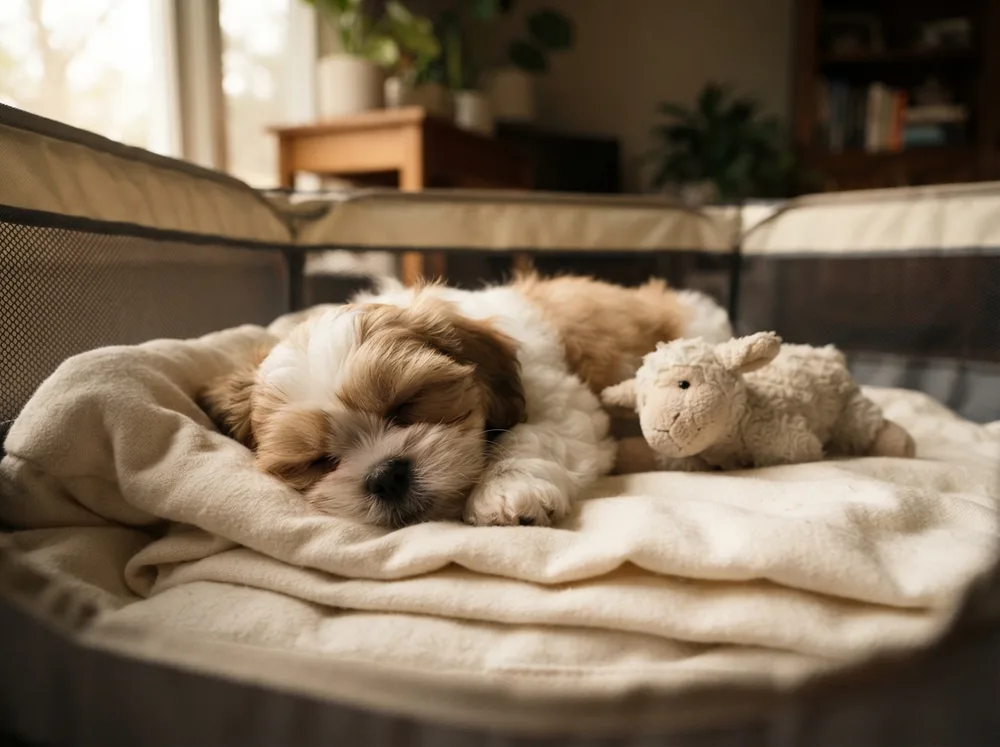
A new Shih Tzu puppy needs one small, calm territory, not the run of your flat. A playpen in a quiet corner, with a pee pad at one end and the bed and water at the other, gives a 9-week-old a den it can actually cope with. Free-roaming a whole HDB flat on day one is how you get accidents behind the sofa and a puppy too overstimulated to sleep.
Airflow matters more here than in most puppy guides, because this is a flat-faced breed in a tropical climate. Park the pen where the fan or aircon reaches it, never in the afternoon sun by a west-facing window.
If your puppy comes from us, this step is done for you: we deliver the puppy home free and set the playpen up ourselves, with a 30-item starter kit ($533 itemized) that includes the pads, bowls and the food the puppy is already on.
The week-one setup
- Playpen in a quiet corner, away from the main walkway
- Pee pad zone at one end, bed and bowls at the other
- A fan or aircon path: flat faces overheat fast
- Chew toys in, dangling cables and shoes out
- Same food the puppy was already eating
Day one: less is more
Day one has one job: decompression. Carry the puppy in, put it in the pen, show it the pee pad, and then do very little. A 9-week-old puppy sleeps 18 hours or more a day, and the move to your home is the most stressful thing that has ever happened to it.
Skip the visitor parade. Shih Tzus are sociable and everyone will want to meet the new arrival, but a queue of grabbing hands on day one teaches the puppy that humans are overwhelming. Family only for the first few days; friends can wait until week two.
Feed the same food, at the same times, that the puppy ate before coming home. A food switch on top of a house move is the classic recipe for a week of loose stools.
Day one has one job: decompression. The cuddles can wait; the routine cannot.
Will my Shih Tzu puppy cry the first night?
Almost certainly yes, and it is normal. Most Shih Tzu puppies cry for the first one to three nights; owners on r/shihtzu and in local pet groups describe the same pattern again and again, a puppy that howls the moment the lights go off and settles within a few nights once it learns you have not vanished.
The kind fix is proximity without surrender. Put the pen where the puppy can see or smell you for the first few nights, take it calmly to the pee pad if it wakes, and keep night contact boring: no lights, no play, no scooping it into bed unless you want a bedmate for the next 14 years.
Never punish the crying. It is not naughtiness; it is a baby animal alone for the first time in its life.
The three-night rule of thumb
Night one is usually the loudest, night two shorter, night three quieter still. If crying is getting worse after a week, something in the routine needs adjusting; message us and we will talk it through with you, free.
How do I toilet train a Shih Tzu in the first week?
Toilet training a Shih Tzu is a timing game you play, not a lesson the puppy learns overnight. Take it to the pee pad after every wake-up, every meal, and every play session; praise within two seconds of it finishing in the right spot. That timing loop, repeated dozens of times, is the whole method.
Set honest expectations: toy breeds have tiny bladders, and the American Kennel Club's Shih Tzu puppy training timeline is measured in months, not days. Most take four to six months to be genuinely reliable. Week one is about building the habit, not finishing it.
Honestly, potty-training a Shih Tzu takes longer than the internet promises. The stubborn charm is part of what you are buying; patience is part of the price. Accidents in week one are your timing being off, not the puppy defying you, and punishing them only teaches it to hide.
2 sec
Praise window
After
Wake, meal, play
4–6 mo
To full reliability
0
Punishments that help
Vaccinations, the vet visit, and when the lift lobby is allowed
Our puppies go home at around week 9, about a week after the second of the three core vaccinations (weeks 6, 8 and 12), with deworming done at every vaccination visit. That schedule decides your week-one geography: until the week 12 jab has settled, the void deck, grass patches and the lift lobby floor are off limits. Carry the puppy if you want it to see the world; do not let its paws touch shared ground.
Book a vet visit within the first few days, records in hand, so your own vet meets the puppy healthy and baselines its weight. It is also your safety net: our 5-day bring-back-if-sick support means anything caught early is on us.
One thing you can cross off the list entirely: licensing. The mandatory AVS dog licence is completed at purchase (a puppy under 5 months is $13.50 for the year), and first-time owners can take the free AVS pet ownership course online. The Shih Tzu is HDB-approved, so the paperwork side of your first week is genuinely zero.
| Item | When | Who handles it |
|---|---|---|
| 2nd core vaccination (week 8) + deworming | Done before go-home | Us, records provided |
| Go-home day | ~Week 9 | Free delivery + playpen setup |
| Your own vet check | Within the first few days | You, records in hand |
| 3rd core vaccination (week 12) | Book it in week one | You; we remind you |
| AVS dog licence ($13.50/yr under 5 months) | Done at purchase | Us |
Start the brushing habit on day two
A Shih Tzu has hair, not fur, and the grooming habit starts in week one or it starts as a fight in month four. From day two, do a 60-second brush and a 30-second face wipe daily, whether the coat needs it or not. Week-one puppy coat barely mats; that is exactly why now is the time, because you are training tolerance, not detangling.
Handle the paws, ears and mouth for a few seconds each day too. Every professional groomer in Singapore can tell a puppy that was handled early from one that was not, and your puppy will be on a groomer's table every 4 to 6 weeks for life, at about $75 to $120 a session.
We include the first professional groom with every puppy, so the introduction to the table happens gently, with a groomer who expects a wriggly beginner. Your job in week one is just to make sure the brush is already a boring, daily, treat-flavoured event.
60 sec
Daily brush, week one
Day 2
When the habit starts
4–6 wks
Lifelong groom cadence
$75–120
Per SG groom session
Singapore heat and the flat face: week-one rules
The Shih Tzu's short muzzle means it cools itself poorly, and a 9-week-old is even worse at it than an adult. In Singapore that is a design constraint, not a footnote: no outings in the midday heat, ever, and naps in the fan or aircon path. Once the vaccinations allow walks, they happen early morning or after sunset.
The prominent eyes need week-one respect too. Brief children before the puppy arrives: no grabbing near the face, no rough play at eye level. We cover the full set of routines, from corridor heat to the one-dog rule, in our guide to living with a Shih Tzu in an HDB flat.
Heat distress is an emergency, not a nuisance
Heavy laboured breathing, bright-red gums, or collapse means cool the puppy down and get to a vet immediately. Do not wait to see if it passes.
How much alone time should a new puppy get?
Some, deliberately, from about day three. It feels wrong to leave a brand-new puppy, but a Shih Tzu is a companion breed with velcro tendencies, and a first week spent glued to you teaches it that your absence is a crisis.
Start tiny: step out of sight for two minutes while the puppy is settled in its pen, return calmly, no fanfare either way. Stretch it to fifteen or twenty minutes by day seven. You are not being cold; you are teaching the single skill that prevents the separation anxiety this breed is prone to.
A realistic day-by-day plan
No puppy reads the schedule, so treat this as a shape, not a script. The pattern that matters: decompress first, layer routines one at a time, and end the week with the foundations booked.
| Day | Focus | The win |
|---|---|---|
| 1 | Decompression: pen, pad, sleep, family only | Puppy eats a normal meal |
| 2–3 | Toilet timing loop starts; first 60-second brush | First pee on the pad, praised in time |
| 4–5 | Vet check with records; name games at mealtimes | Puppy looks up at its name |
| 6–7 | Short alone-time reps; book the training lesson and week 12 jab | Two minutes alone without drama |
The week-one mistakes owners report most
A recurring thread in Shih Tzu owner forums is not "my puppy is broken" but "I wish I had known". The same five regrets come up over and over.
Five things owners say they would undo
- The day-one visitor parade that left the puppy frantic for days
- Free-roaming the whole flat, then blaming the puppy for accidents
- Punishing accidents, which taught the puppy to pee behind furniture
- Skipping brushing "because the coat looks fine", until it did not
- Switching food immediately and spending week one cleaning up the result
When to worry, and when to just message us
Normal in week one: crying at night, a couple of loose stools in the first 48 hours, marathon sleeping, and a puppy that ignores its expensive bed to sleep on the tiles. Not normal: refusing food for more than 24 hours, repeated vomiting, watery diarrhoea, or a puppy that is limp and uninterested in anything. Those mean a vet, today.
Every puppy we place comes with 5-day bring-back-if-sick support and free ongoing care advice on WhatsApp, so the honest answer to "is this normal?" at 10pm on day three is: ask us. We have walked more than 30 Singapore families through this exact week.
What our puppies come home with
Most of this guide's setup work is bundled into how we hand over the healthy Shih Tzu puppies we place across Singapore: vet-checked, microchipped, second vaccination done, licence sorted, playpen assembled in your flat before we leave. Priced from $3,888, all-in.
The free first training lesson with an AVS-certified trainer is the piece we would nag you about: book it during week one, while the habits are still wet cement. And the honesty gate applies before any of it: a Shih Tzu needs a daily brush and a $75 to $120 groom every 4 to 6 weeks for life. If that budget line works for you, come meet our available Shih Tzu puppies.
Included with every Shih Tzu
- Starter kit: 30 items, $533 itemized value
- Free home delivery and playpen setup
- Free first lesson with an AVS-certified trainer
- First professional groom included
- AVS licensing completed at purchase
- 5-day bring-back-if-sick support
Keep exploring
Frequently asked questions
How long will a Shih Tzu puppy cry at night?
Usually one to three nights, loudest on the first. Keep the pen near you at first, keep night toilet trips boring, and never punish it. Crying that worsens after a full week means the routine needs adjusting.
When can my Shih Tzu puppy go outside in Singapore?
Carried, immediately; on the ground, only after the week 12 vaccination has settled. Until then, avoid void decks, grass patches and lift lobby floors, and never go out in midday heat with a flat-faced puppy.
How long can I leave a new Shih Tzu puppy alone?
Minutes, not hours, in week one. Start two-minute absences from about day three and build to fifteen or twenty minutes by day seven. Deliberate short absences now are what prevent separation anxiety later.
What should a 9-week-old Shih Tzu eat?
Exactly what it was eating before it came home, three meals a day, with water always available. Keep the diet unchanged for at least the first week; transition to a new food gradually over seven days only after the puppy has settled.
When should a Shih Tzu puppy have its first professional groom?
Once vaccinations are complete, typically within the first couple of months home. Ours include the first professional groom, but your week-one job matters more: a daily 60-second brush and gentle handling of paws, ears and face.
How long does it take to toilet train a Shih Tzu?
Most toy breeds take four to six months to be reliable. Week one builds the habit: pee pad after every wake, meal and play, praise within two seconds. Accidents are timing errors, not defiance.
Do I need a dog licence for a Shih Tzu puppy in Singapore?
Yes, an AVS dog licence is mandatory, $13.50 a year for a puppy under 5 months. If your puppy comes from us the licence is completed at purchase, so there is nothing to file in week one.
Meet your Shih Tzu
Come say hello at Balestier
2 Balestier Road #01-701, Singapore 320002 · Weekdays 12pm–6pm · Weekends 10am–6pm. Or message us first: tell us about your home and routine, and we'll tell you honestly if a Shih Tzu fits.
Still deciding?
Read the price guide first: every dollar explained, no surprises at the shop.
See the price guide