HDB living
Living With a Shih Tzu in an HDB Flat
A Shih Tzu weighs 4 to 7.5 kg, sleeps most of the day, and asks for a five-minute brush and two short walks. Here is what a Shih Tzu HDB flat routine actually looks like: the setup, the heat, the corridor, the neighbours, the groomer.
Nelson and Kim, Curious Tails · AVS licence AS24J00046
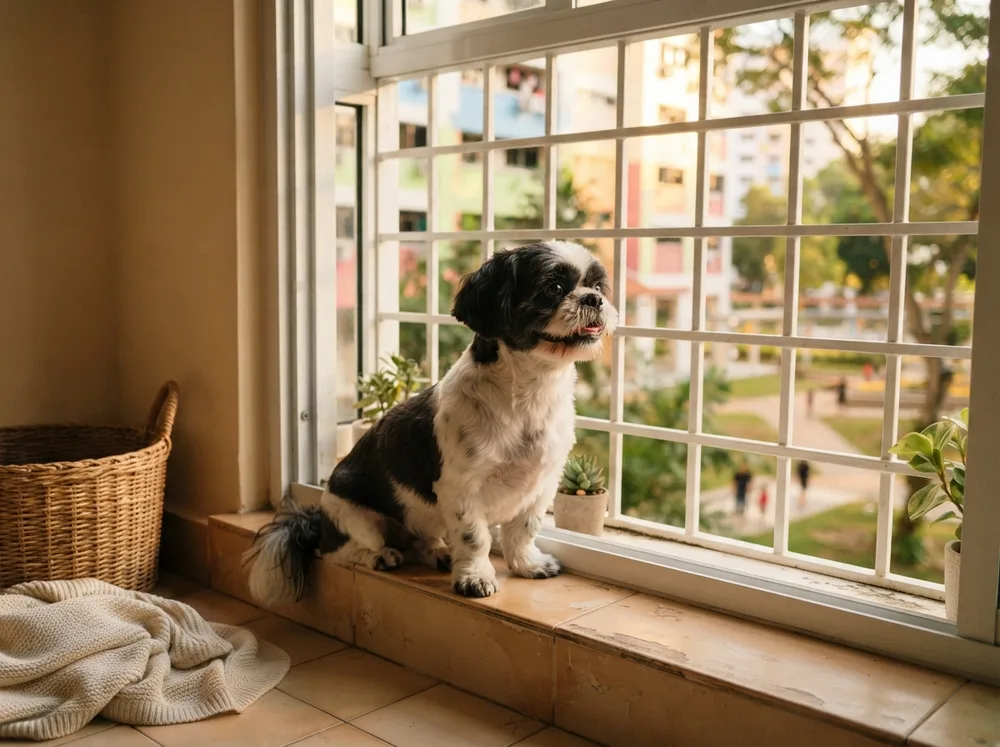
Can a Shih Tzu live happily in an HDB flat?
Yes. At 4 to 7.5 kg with low exercise needs and a calm indoor temperament, the Shih Tzu is one of the best-suited HDB approved dog breeds for flat living. Three conditions make it work. Brush daily, book a professional groom every 4 to 6 weeks, and walk before 9am or after 7pm.
The HDB-approved lion dog, honestly
Why does a Shih Tzu suit a flat better than most dogs?
Ask whether a Shih Tzu is good for apartment living and the honest answer is yes, with conditions attached. This is a small breed companion dog that was bred to live indoors, at someone's feet, with no working job to do. That history shows up as low exercise needs and a Shih Tzu temperament that is calm, sociable and happiest indoors. An adult stands 20 to 28 cm at the shoulder and weighs 4 to 7.5 kg, so a 3-room flat is generous territory rather than a compromise.
Sturdiness matters more in a flat than people expect. The Shih Tzu is an affectionate lapdog without being a fragile one, which is why it lands so often in a multigenerational household with grandparents, toddlers and a lot of foot traffic through a 4-room flat. Good with children and the elderly is not marketing here, it is the job the breed was built for. It greets guests instead of hiding from them.
Shih Tzu apartment living gets sold as effortless, and the trade-off nobody mentions is company. This breed wants to be in whichever room you are in, which is easy in 90 square metres and much harder in a flat where nobody is home from 8am to 8pm. Space is not the real constraint on Shih Tzu flat living in Singapore. Attention, grooming and heat are.
The flat-friendly breed, by the numbers
- Weight: 4 to 7.5 kg, adult
- Height: 20 to 28 cm at the shoulder
- Exercise: two short walks, 30 to 45 minutes total
- Indoors: calm, sociable, moderate alert barker
- Coat: hair not fur, so daily brushing
- HDB: approved, item 48 on the current list
The rules, in one minute
The Shih Tzu HDB rules fit in a paragraph. You may keep one dog per HDB flat, it must appear on the HDB approved dog breeds list, and it must hold a valid AVS dog licence. That list of approved small dog breeds runs to about 62 approved breeds, and the Shih Tzu sits at item 48 on the current version, so approval is settled before you start. The HDB guidelines on keeping pets are the primary source and worth ten minutes of your time.
HDB pet rules are the easy half of keeping a dog in an HDB flat. The licence side is where new owners get caught out, because the dog has to be microchipped and licensed as well as vaccinated, you sign the Code of Responsible Behaviour, and first-time owners complete the AVS pet ownership course first. We handle the licensing at the point of purchase for every puppy we place, so it is one less form in your first week. The complete rule set, including how a cross of two approved breeds is treated and what happens with a dog that is not on the list, sits on our page of HDB rules for keeping a Shih Tzu. The rest of this guide assumes the paperwork is done and gets on with the living.
The one-minute rule check
- One approved dog per HDB flat
- The Shih Tzu is item 48 on the current approved list
- AVS dog licence: microchipped and licensed, vaccinated, signed CORB
- First-time owners complete the AVS pet ownership course
- We handle the licensing when you collect your puppy
How do you set up an HDB flat before the puppy arrives?
Every Shih Tzu HDB flat setup starts with four zones, not a pile of products. The dog needs a playpen corner, a toilet area, fresh water stations and a gated kitchen, and laying those out before the puppy walks in does most of your toilet training for you. It takes an afternoon.
Put the playpen corner out of the direct afternoon sun and out of the aircon draught. West-facing flats bake from about 2pm, and a dog forced to choose between roasting and shivering will simply move somewhere you did not plan. A crate and playpen in a wall corner with a view of the room beats a spare bedroom, because this breed settles faster when it can see you.
Pee tray placement is the detail that decides your first month. The tray belongs in the service yard or the bathroom, never within a metre of the food bowl, because dogs will not toilet where they eat and a tray parked beside dinner is the most common reason a puppy picks the living room rug instead. Gate the kitchen, run a balcony safety check on the gaps and the window grilles at dog height, and keep the bomb shelter storage for the kit rather than for the dog.
We deliver every puppy and set the playpen up in your flat, free, so the zones exist before the dog does. Night one in a new flat goes better when nothing has to be improvised, and the settling in period is shorter when the puppy wakes up in the same corner it fell asleep in.
Zone by zone, before day one
- Playpen corner: off the afternoon sun and the aircon draught
- Toilet area: service yard or bathroom, never beside food
- Fresh water stations: two, living room and pen
- Kitchen gated, balcony safety checked at dog height
- Bomb shelter storage for the kit, never for sleeping
- Free home delivery and playpen setup with every puppy
Tiles, rugs and small-dog knees
Tile floors are the most underrated hazard in a flat with a small dog. Polished HDB tile and vinyl give a Shih Tzu's paws almost nothing to grip, so the dog braces on every turn and skids on every excited sprint to the front door. Slippery floors for small dogs are not a cosmetic problem, and the bill arrives in the knees over years, not days.
The fix is cheap and permanent. Rugs and runners down the main hallway and along the route to the toilet area give the dog a grip lane. Anti-slip mats at the two or three launch points, usually the sofa and the bed, take the impact out of jumping down, and a low step or a small ramp at the sofa is better again.
Ask your groomer to trim the hair between the paw pads at every visit. It takes two minutes, costs nothing extra, and it is the difference between a dog that walks on tile and a dog that surfs it. Keep the nails short enough that you cannot hear them clicking down the corridor.
The anti-slip kit, under fifty dollars
- Runner down the main hallway
- Runner along the route to the toilet area
- Anti-slip mat at the sofa and at the bed
- Paw-pad hair trimmed at every groom
- Nails short enough to stop the clicking
What does a real weekday with a Shih Tzu look like?
Two short walks, a five-minute brush, and a great deal of sleeping. The daily routine for a Shih Tzu in a Singapore flat needs roughly 30 to 45 minutes outdoors, split into a morning walk before 9am and a second walk after 7pm. The middle of the day belongs to a fan, fresh water and a nap.
A weekday routine with a dog in Singapore is dictated by the climate, not by the dog's energy. Owners who run a normal dog schedule end up marching a flat-faced breed through the hottest hours of the afternoon, which is where the trouble starts. Never walk at midday. Build the day around the two cool windows and everything else fits around them.
Nothing on this timetable takes long. The brush is five minutes if you do it daily and twenty-five if you skip three days, which is the entire argument for doing it daily. Indoor play fills whatever is left, and there is usually less of it than new owners expect.
| Time | What happens | Why it works |
|---|---|---|
| 6.45 to 7.30am | Toilet, then a 15 to 20 minute walk | Coolest air and coolest pavement of the day |
| After breakfast | Five-minute brush, ears and armpits first | Humidity mats a coat fastest where it rubs |
| 9am to 6pm | Sleep, a chew, one puzzle feeder | A settled adult sleeps most of the workday |
| Midday | Fan or aircon on, water topped up, no walk | Radiant heat and pavement temperature peak here |
| 7.00 to 7.45pm | Second walk, park connector pace | Radiant heat gone, surfaces cooling |
| Evening | Sniff games, five minutes of training, lap time | Mental work tires a flat dog more than distance |
| Before bed | Last toilet trip, eyes and face wiped | Keeps tear staining and night accidents down |
Heat: the one rule you cannot bend
Heat sensitivity is the one part of Shih Tzu ownership in Singapore with no flexibility in it. The Shih Tzu is a brachycephalic breed, and that short muzzle shortens the airway panting depends on. In Singapore heat and humidity, at 30 to 33 degrees with the air above 80 percent moisture, a midday walk is off the table every month of the year, not only on the days that feel hot.
Treat cooling as equipment rather than luxury. Aircon and fans are the baseline here, along with a patch of bare tile the dog can sprawl on, a cooling mat if your dog will use one, and water in two places. On the worst afternoons a couple of hours of aircon is the kindest money in the budget. Never leave a Shih Tzu on an unshaded balcony, in a parked car, or shut in a room with no moving air.
Heat stress signs are worth memorising before you need them. The rule after that never changes. Cool the dog and get to a vet. The full routine, including the national heat stress advisory you can check before a walk and the exact first-aid order if things go wrong, is in our guide to keeping a Shih Tzu cool in Singapore heat.
Heat stress signs, and what you do
- Heavy laboured breathing, bright-red gums, heavy drooling
- Staggering, weakness, refusing to move, collapse
- Move into shade or aircon, wet the coat with room-temperature water
- Fan the wet coat, offer small sips, then drive to a 24-hour vet
Will the neighbours hear your Shih Tzu?
Sometimes, yes. Alert barking is this breed's contribution to flat life, and Shih Tzus are moderate alert-barkers rather than yappers. The triggers are predictable. Barking at the lift chime, at the doorbell, at footsteps in the HDB corridor. Training shortens the bark and rarely deletes it, so the honest question is whether it stops when you ask.
Leash manners in corridors do more for neighbour relations than any training class. Put the leash on before the door opens, never after. In a busy lift lobby, either carry the dog in the lift or keep it on a short leash at your feet, because a small dog at ankle height in a crowded car is both a trip hazard and a bite risk. Socialising in the lift early, and letting the puppy meet neighbours and their dogs calmly on the way out, is what turns a reactive puppy into a boring one.
Shared walls turn barking management from a nice-to-have into an obligation, and quiet hours are when a bark costs you the most goodwill. If a complaint does land, handle it like a neighbour rather than a case file. SOSD's guidance for HDB dog owners who receive a complaint starts in the right place, which is finding out what the behaviour actually is and fixing that, then confirming your AVS licence is current. Shih Tzu Singapore owners in local forums report the same pattern, which is that complaints usually trace back to barking during empty-flat hours. That is an alone-time problem wearing a barking costume.
Training shortens the alert bark. It rarely deletes it. Decide whether you can live with that before the puppy arrives, not after the first knock on the door.
| Stage | What happens | What you do |
|---|---|---|
| The knock | A neighbour raises it directly | Listen, ask exactly when the barking happens, thank them |
| Find the trigger | Usually alone time, the lift or the corridor | Check a camera on the empty-flat hours before you guess |
| Fix the cause | Trigger training and a longer alone-time build-up | Book a trainer early, not after warning letters |
| RC or town council | Informal mediation between both households | Turn up, and show what you have already changed |
| HDB | Follow-up on pet-keeping conditions | Keep the AVS licence and your records current |
Pee tray or downstairs? Pick one and hold it
Both work. Toilet training a Shih Tzu with a tray in the service yard suits owners who work full days and the months when it rains every afternoon. A toilet downstairs routine suits households with a fixed schedule and a quick route to grass. What ruins the training is switching between them, so pick the system your worst week can sustain.
Then hold it for months, not weeks. Potty training indoors is no faster than outdoors, and either way a Shih Tzu learns more slowly than the internet promises. Full reliability commonly takes four to six months rather than four to six weeks. The stubborn streak is part of the charm you are buying, and patience with toilet training is part of the price.
Puppy pads inside the tray help for the first fortnight, then come out, so the dog does not decide that all soft floor coverings are fair game. Accident cleanup matters more than scolding. Use an enzyme cleaner rather than anything ammonia-based, because ammonia reads as urine to a dog and re-marks the spot as a toilet. Every puppy we place comes with a free AVS-certified training lesson, so use it in week two while the habits are still forming, not in month three when you are already frustrated.
Choosing your toilet system
- Full workdays, or no quick route downstairs: tray in the service yard
- Toilet downstairs routine: same spot, same order, every time
- One system only, held for at least three months
- Full reliability commonly takes 4 to 6 months
- Enzyme cleaner for accidents, never ammonia
How much grooming does a flat-kept Shih Tzu actually need?
A five-minute brush every day and a professional groom every 4 to 6 weeks. Shih Tzu coat is hair not fur, so it grows continuously and never sheds itself clean. Low shedding high maintenance is the honest label. The grooming cost Singapore owners actually pay is $75 to $120 a session, about $900 to $1,400 a year, for the dog's whole life.
Matting in humidity is what turns this into a daily job rather than a weekly one. Mats behind the ears come first, then under the collar, in the armpits and at the back of the hind legs, because those are the places the coat rubs and traps damp. Start the brush there and you have covered most of the risk before you touch the rest of the dog. A top-knot keeps hair out of the eyes, and wiping the face daily stops tear stains setting into a light coat.
A small flat helps here. The dog is never more than a few metres away, so brushing becomes something you do while the kettle boils rather than an event you schedule. The puppy cut is the practical short cut for the tropics, brief enough to lose the insulation and easy enough to maintain between salon visits. Our page on Shih Tzu grooming in Singapore has the full breakdown, and every puppy we place goes home with the first professional groom included. Budget a groomer on retainer, not an occasional treat.
The grooming ledger
- Daily brush: five minutes, ears and armpits first
- Professional groom: every 4 to 6 weeks
- Per session: $75 to $120
- Per year: about $900 to $1,400
- Practical cut for the tropics: the puppy cut
- Included with our puppies: the first professional groom
Can you leave a Shih Tzu alone while you work?
Yes, once alone time training has been done properly. A settled adult Shih Tzu sleeps through most of a workday, and a flat is easier to make safe than a house. The failure mode is jumping from constant company in week one to nine hours left alone while at work in week three, which is how a quiet dog becomes a barking one.
Build it up from day one in short blocks. Leave the room, come back before there is any fuss, then stretch the gap. Leave water, a toilet option and something worth chewing. Camera check-ins are worth more than any advice on this page, because they show you what actually happens in the empty flat instead of what you imagine happens, and they tell you early whether you are looking at boredom or genuine separation anxiety.
A bored Shih Tzu barks. A settled one sleeps on the coolest tile it can find and hears you at the lift before you reach the door.
Alone-time build-up, week one
- Days 1 to 3: leave the room, return before any fuss
- Days 4 to 7: ten minutes, then thirty, then an hour out of the flat
- Always leave water, a toilet option and a chew
- Camera the first full workday before you assume the worst
- Keep arrivals and departures boring
Exercise without a garden
No garden is a smaller problem than most first-time owners expect. Two short walks a day cover a Shih Tzu's physical need, and the breed's genuinely low exercise requirement is the whole reason it suits flats. This is not a dog that needs a lawn to be happy.
Park connector walks do the work a garden would. NParks maps every park and park connector that allows pets, so you can find the nearest green route from your block instead of walking the same pavement loop for twelve years. At weekends the free dog runs are worth the trip, and several sit within reach of an HDB estate, including West Coast Park, Bedok Town Park and Potong Pasir. The Bishan Park dog run is the useful one for this breed, because it is split into separate pens and a 5 kg dog is not mobbed by a 25 kg one.
The other half of the job is mental stimulation. Scatter dinner across a rug instead of using a bowl, hide treats around the living room, rotate two puzzle feeders, and spend five minutes on training every evening. Sniffing and thinking tire a small indoor dog far faster than distance does, which is exactly what you want in a flat.
30–45 min
Outdoor need per day
2 walks
Split morning and evening
Before 9am
The main walk window
After 7pm
The second walk window
What does a Shih Tzu cost to run in a flat?
The groomer, mostly. The monthly cost of a Shih Tzu in an HDB flat is dominated by one line, and it adds up to about $900 to $1,400 a year in grooming, which beats food, licence and routine vet care combined for most owners. Flat-specific gear is a one-off. Grooming is the standing bill.
Setup costs are smaller than people fear. A crate, a playpen, a tray, a couple of runners and some anti-slip mats cover the flat-specific list, and the starter kit included with every puppy we place covers 30 of them, an itemised $533 of value, delivered and set up free. The runners and mats are the line most guides forget, and they come in under fifty dollars.
Beyond that, the cost of owning a dog in Singapore is a food and treats budget, routine vet visits, annual vaccinations and the pet insurance many Singapore owners now take out. Our Shih Tzu puppies are $3,888 to $4,888 all-in, with licensing handled at purchase and the first professional groom included. For the full picture across a 12 year commitment, we set out the real lifetime cost in detail.
| Line | Typical cost | How often |
|---|---|---|
| Professional groom | $75 to $120 | Every 4 to 6 weeks |
| Grooming, per year | About $900 to $1,400 | Every year, for life |
| Crate, playpen, tray, bowls | Included in our starter kit | One-off, delivered and set up free |
| Anti-slip runners and mats | Under $50 | One-off, replace as they wear |
| Puppy, all-in | $3,888 to $4,888 | Once, first professional groom included |
Who should not keep a Shih Tzu in a flat
Honestly, this is the section we would rather you read twice. Who should not get a Shih Tzu is a shorter list than you might think, but it is a real one, and we have turned buyers away over it.
If nobody in the flat will brush a dog every single day, the Shih Tzu is the wrong breed for you, and no amount of enthusiasm on collection day changes that. If you need silence behind a shared wall, pick differently. If you want a dog that jogs with you at lunchtime, the flat face rules it out in this climate, and pretending otherwise is how a Tuesday afternoon turns into an emergency vet run.
Honest breed advice is the whole reason we qualify on grooming-readiness before anyone gets to price. We would rather talk you out of the wrong breed than sell you the wrong dog, which is why the first thing our Shih Tzu specialists in Singapore ask about is brushing, not budget. Every one of the 30+ Shih Tzus we have placed left as a vet-checked puppy, microchipped, with vaccination records and the microchip number in the folder.
Everyone else, and that is most HDB households, gets a dog that was built for exactly the life they already live.
We would rather talk you out of the wrong breed than sell you the wrong dog.
Signs the Shih Tzu is wrong for your flat
- Nobody at home will brush the dog daily
- You need a silent dog behind a shared wall
- You want a midday running or hiking companion
- The budget has no room for $900 to $1,400 a year of grooming
- You expect a dog that trains fast and obeys first time
Keep reading the HDB living cluster
Frequently asked questions
Are Shih Tzus good for apartment living?
Yes. At 4 to 7.5 kg with low exercise needs and a calm indoor temperament, the Shih Tzu is one of the best-suited breeds on HDB's approved list. The conditions are daily brushing, a professional groom every 4 to 6 weeks, and walks timed around Singapore's heat.
How many dogs can I keep in an HDB flat?
One, and it must come from HDB's approved list of about 62 small breeds. The Shih Tzu is on that list at item 48. The complete rules, including what happens with a dog that is not approved, sit on our HDB page.
Can I leave my Shih Tzu alone in the flat while I work?
Yes, once alone time is trained in gradually. A settled adult sleeps through most of the workday. Leave water, a toilet option and something to chew, and build up from short absences in week one rather than jumping straight to nine hours.
Should I use a pee tray or bring my Shih Tzu downstairs?
Either works, and consistency is what actually matters. A tray in the service yard suits working owners and the rainy months, while a downstairs routine suits fixed schedules. Pick one and hold it for at least three months, because Shih Tzus train slower than average.
Do Shih Tzus bark a lot in HDB flats?
They are moderate alert-barkers. The lift, the doorbell and footsteps in the corridor are the usual triggers. Training shortens the bark but rarely removes it, and most neighbour complaints trace back to barking during empty-flat hours rather than to the dog itself.
Does a Shih Tzu need aircon in Singapore?
Treat cooling as essential rather than optional. The flat face makes Shih Tzus heat-sensitive, so a fan at dog height, a patch of bare tile and fresh water are the daily baseline, with a couple of hours of aircon on the hottest afternoons.
Is a Shih Tzu HDB approved?
Yes. The Shih Tzu appears on HDB's current approved list at item 48. You still need an AVS licence, with the dog microchipped and vaccinated, and you sign the Code of Responsible Behaviour before the licence is issued.
Meet your Shih Tzu
Come say hello at Balestier
2 Balestier Road #01-701, Singapore 320002 · Weekdays 12pm–6pm · Weekends 10am–6pm. Or message us first: tell us about your home and routine, and we'll tell you honestly if a Shih Tzu fits.
Ready for the brushing?
A Shih Tzu needs a daily brush and a $75 to $120 groom every 4 to 6 weeks, about $900 to $1,400 a year. If that is a yes, we should talk.
See the grooming reality