Training & temperament
Housetraining a Shih Tzu, honestly
The realistic timeline, the HDB toilet-spot decision, the week-by-week routine, and what to do when a stubborn little lion dog regresses. No two-week fairy tales.
Nelson and Kim, Curious Tails · AVS licence AS24J00046
How do you housetrain a Shih Tzu?
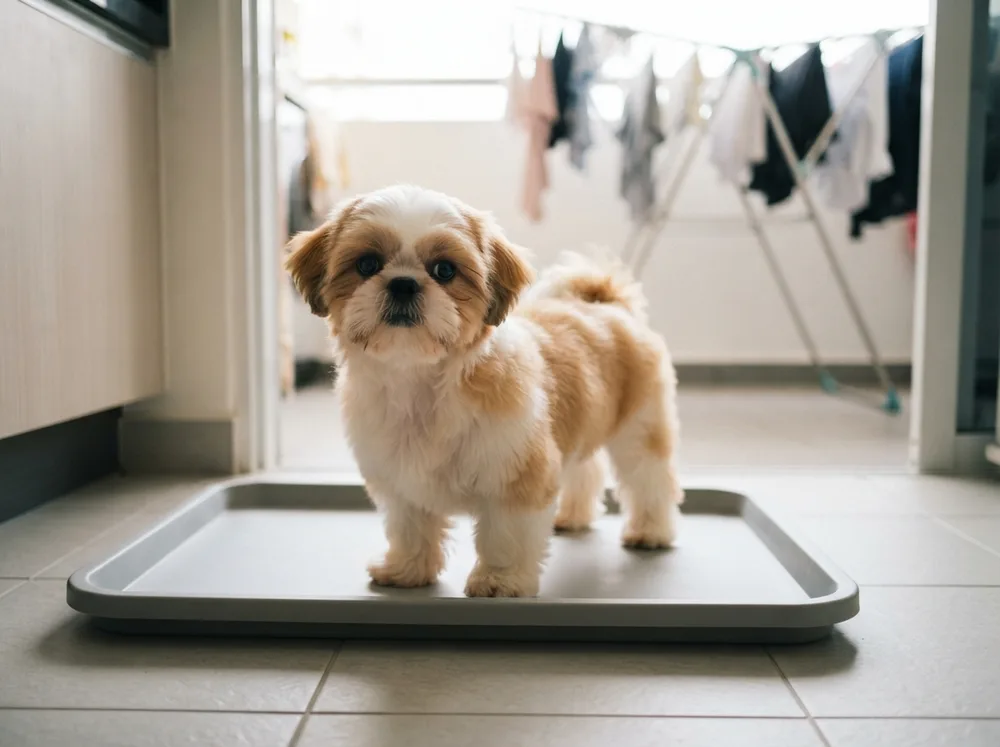
Housetraining a Shih Tzu means one fixed toilet spot, a strict routine of scheduled meals and timed trips, confinement between trips, and a reward within seconds of success. Expect 4 to 8 months to full reliability, not the two weeks the internet promises. The method works fine in an HDB flat; the breed just makes you earn it.
Patience is part of the price
The honest timeline: how long does it really take?
Housetraining a Shih Tzu takes most owners 4 to 8 months to reach genuine reliability, and even vet-approved potty training guides put the range at several weeks to several months. The "toilet trained in two weeks" claim you see on generic puppy sites is marketing, not this breed.
We say this before anyone buys, not after. Potty-training a Shih Tzu takes longer than the internet promises; stubborn charm is part of what you are buying, and patience is part of the price. A puppy that has accidents at five months is not broken. It is on schedule.
4–8 mo
To reliably trained
~1 hr
Bladder hold per month of age
8–10
Toilet trips a day at first
Wk 9
When puppies go home
Why are Shih Tzus hard to potty train?
Shih Tzus are hard to potty train because they combine a clever, independent mind with a toy-breed bladder. A puppy can hold on for roughly one hour per month of age, so a nine-week-old physically cannot wait through your meeting, and a smart dog with options will pick the rug.
It is low compliance, not low intelligence. The breed was bred for a thousand years to be a companion, not to take orders, and the American Shih Tzu Club's housetraining notes lean on routine and management for exactly that reason. It also matches the rest of the Shih Tzu temperament: affectionate, personable, and quietly convinced it knows better. You can read more about that in our guide to the Shih Tzu temperament before you commit.
Stubborn is the personality you chose. Routine is how you win anyway.
Pick the toilet spot first: the HDB decision
In an HDB flat, the toilet spot is a real decision, because "just open the back door" does not exist twelve floors up. A nine-week-old puppy cannot hold its bladder through a lift ride, a lobby, and a walk to the grass verge, so most flat owners start indoors and add the outdoors later.
Whatever you choose, choose once. Moving the pad from service yard to balcony to bathroom mid-training resets the map in the puppy's head and adds weeks.
| Setup | Best for | The catch |
|---|---|---|
| Pee pad in the service yard or bathroom | Working owners; the first 3 to 4 months; rainy season | Pads cost roughly $15 to $25 a month, and some dogs shred them |
| Fake grass tray on the balcony | Owners planning an outdoor switch later; dogs that refuse pads | Needs rinsing every day or two in Singapore heat, or it smells |
| Downstairs at the void deck or grass verge | Older puppies with vaccinations complete; retirees home all day | Lift-ride accidents at first; midday heat rules out a flat-faced breed |
The routine that actually works, week by week
The routine is the whole method: scheduled meals in, scheduled toilets out. Feed at the same times daily, then bring the puppy to the spot at every high-risk moment: on waking, after every meal, after every nap, after play, and last thing at night. That is 8 to 10 trips a day in the early weeks.
At the spot, say one cue word, wait quietly, and the moment the puppy finishes, treat and praise within seconds. Timing is the training; a treat delivered back in the kitchen rewards walking to the kitchen.
For the first fortnight, the puppy lives in a playpen beside the pad whenever you cannot watch it, including overnight. Dogs avoid soiling where they sleep, so confinement teaches holding. Earn freedom one room at a time: a week with no accidents buys the living room, not the whole flat.
The daily trip list
- First thing on waking, every morning
- After every meal (10 to 20 minutes later)
- After every nap and play session
- Once mid-afternoon and mid-evening
- Last thing before lights out
- On any sniffing, circling, or sudden pause
What do you do when accidents happen indoors?
When your Shih Tzu has an accident, interrupt calmly, carry the puppy to the toilet spot, and reward anything finished there. Never punish. This breed is sensitive; scolding does not teach "toilet here", it teaches "hide from the human first", which is why vets advise a positive and steady approach over correction.
Then clean the spot with an enzyme cleaner, not household detergent. Leftover scent reads as a signpost, and one un-cleaned corner becomes the flat's unofficial second toilet. Keep a simple log of where and when accidents happen; the pattern almost always points at a missing trip in your routine, not a defiant dog.
The five mistakes that add months
- Too much freedom too soon: the whole flat on day one
- Moving the pad around mid-training
- Punishing accidents (creates a sneaky toileter, not a trained one)
- Different rules per family member: agree the routine, stick to it
- Quitting the schedule after the first dry week
Trained, then peeing inside again? Read this first
Regression is the most common toilet complaint owners raise after the puppy stage, and it usually has an ordinary cause: adolescence around 6 to 10 months, a routine change, or freedom granted faster than the training earned. The fix is boring and effective; shrink the world back to week-one rules for a fortnight and rebuild.
Marking is different from toilet failure: small, deliberate amounts on vertical spots, most common in unsterilised adolescents. Sterilisation and management usually settle it.
When the answer is a vet, not more training
A previously reliable dog that suddenly pees indoors, strains, dribbles, or goes far more often may have a urinary tract infection, which is common in small breeds. Rule that out before restarting any training plan.
Working full-time in a flat: can it still work?
Yes, with honest arithmetic. The hold rule sets the ceiling: a three-month-old holds roughly three hours, so a nine-to-six household cannot leave a young puppy padless and expect dry floors. Three real setups we see in Singapore homes:
A work-from-home couple can run the full trip schedule and usually trains fastest. An office family keeps the playpen-plus-pad setup as the safety valve and adds a midday break, a helper, or a pet sitter for the first months. A retiree household often skips pads entirely and trains straight to the void deck, walking early or late because a flat-faced breed and midday Singapore heat do not mix. There is more on realistic absence limits in our post on leaving a Shih Tzu home alone.
Use the free training lesson early, not in month three
Every Shih Tzu we place comes with a free first lesson with an AVS-certified trainer, plus home delivery and playpen setup, so the confinement area is built correctly on day one. Book that lesson in the first fortnight; toilet routine is exactly what it is for, and a good first month beats three months of undoing bad habits.
Part of how we work when matching Shih Tzu puppies to Singapore families is asking about patience before price. If a slow-training breed does not fit your household, we would rather say so at the shop, which is also why our licence is checkable on the AVS public registry.
Included with every puppy
- Free first lesson, AVS-certified trainer
- Home delivery and playpen setup
- 30-item starter kit ($533 itemised value)
- Licensing paperwork done at purchase
- Ongoing care advice on WhatsApp
What Shih Tzu owners actually report
The recurring thread in owner communities like r/shihtzu is the same one we tell buyers: months, not weeks. Owners commonly report puppies that were solid at home but lost the plot after a house move, and pad-trained dogs that took a month of double-duty routine to accept going downstairs instead.
The happy endings share one feature. Nobody credits a trick; everybody credits a boring routine held long past the point it felt necessary.
Nobody credits a trick. Everybody credits the boring routine.
Verdict: should the stubborn streak put you off?
If you can give six months of fixed routine, no. The same temperament that toilet-trains slowly is what makes the Shih Tzu a warm, funny, flat-sized companion for the next decade, and the process needs consistency more than talent.
If you need a fast, eager-to-comply trainee, honestly, pick another breed. We'd rather talk you out of the wrong breed than sell you the wrong dog; that policy has served 30+ Shih Tzu families so far, and it applies to toilet training too.
Keep exploring
Frequently asked questions
How long does it take to housetrain a Shih Tzu?
Most Shih Tzus take 4 to 8 months to become genuinely reliable, with good progress from around month three if the routine is consistent. Claims of two weeks describe lucky days, not trained dogs.
Are Shih Tzus hard to potty train?
Harder than average, yes. They pair a small bladder with an independent streak, so they need more repetitions and stricter routine than a biddable breed. They get there; they just refuse to rush.
Should I use pee pads or take my Shih Tzu downstairs in an HDB flat?
Start with a pad or grass tray in one fixed spot; a young puppy cannot hold through a lift ride and walk. Add downstairs trips once vaccinations are complete, and keep the indoor option for rain and hot afternoons.
Why is my Shih Tzu suddenly peeing inside again?
Usually adolescence, a routine change, or freedom granted too fast; shrink back to week-one rules for two weeks. If the change is sudden in a previously reliable dog, see a vet first to rule out a urinary tract infection.
Can I toilet train a Shih Tzu if I work full-time?
Yes, with a playpen-and-pad setup and someone covering a midday break for the first months. A three-month-old holds roughly three hours, so an unattended nine-hour day without a pad guarantees accidents.
Should I punish my Shih Tzu for accidents?
No. Punishment teaches this sensitive breed to hide and toilet secretly, which is worse. Interrupt calmly, carry the puppy to the spot, reward success there, and clean the accident with an enzyme cleaner.
At what age can a Shih Tzu puppy start toilet training?
From the day it comes home, which for our puppies is around week nine. Start the fixed spot and trip schedule on day one; the first fortnight sets the pattern for everything after.
Meet your Shih Tzu
Come say hello at Balestier
2 Balestier Road #01-701, Singapore 320002 · Weekdays 12pm–6pm · Weekends 10am–6pm. Or message us first: tell us about your home and routine, and we'll tell you honestly if a Shih Tzu fits.
Still sizing up the breed?
Read what the Shih Tzu is actually like to live with before you commit to the routine.
Read the temperament guide