Training & temperament
Can you leave a Shih Tzu home alone?
The real hour limits by age, what separation anxiety looks like, and how Singapore's long workdays actually fit around a breed built for company.
Nelson and Kim, Curious Tails · AVS licence AS24J00046
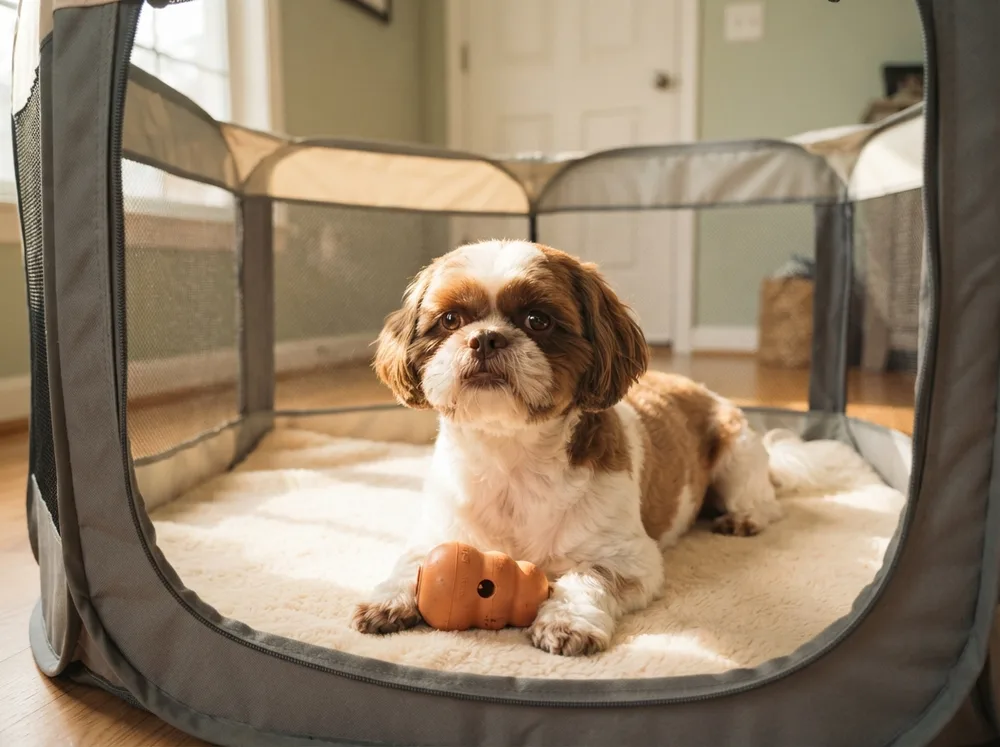
How long can you leave a Shih Tzu alone?
Up to 4 hours for a puppy under 6 months, and 6 to 8 hours for a trained adult; treat 8 hours as the ceiling, not the routine. The Shih Tzu was bred purely for human company, so coping alone is a skill you train, never something to assume.
Company is the whole job description
The honest hour limits, age by age
A Shih Tzu's safe alone time is set by two clocks: the bladder and the loneliness. The bladder clock is physical; a young puppy simply cannot hold it. The loneliness clock is emotional, and for this breed it runs faster than for most small dogs.
The figures below follow the vet-reviewed Dogster guidance (reviewed by Dr Marta Vidal-Abarca): 4 hours maximum under 6 months, building to 6 to 8 hours as a trained adult. Both clocks matter; meeting the bladder limit while ignoring the loneliness limit is how you end up with a chewed door frame.
| Age | Maximum alone | The limiting factor |
|---|---|---|
| Under 6 months | 4 hours (start at 15 minutes) | Bladder control and puppy development |
| 6 months to adult | Build gradually towards 6 hours | Alone-time training, not just age |
| Trained adult | 6 to 8 hours, 8 is the ceiling | Loneliness and boredom, plus one toilet break |
| Senior or unwell | Shorter again, 2 to 5 hours | Bladder, joints, and medication timing |
Why Shih Tzus struggle with being alone
The Shih Tzu is a companion breed in the strictest sense: it was bred to sit with people, first in Chinese palaces, and it has no working-dog independence to fall back on. A terrier alone finds a project; a Shih Tzu alone waits for you.
That is the same affectionate, people-centred nature that makes them such good flat dogs, and you can read more about it in our guide to what the Shih Tzu temperament is really like. The trade-off is that a lonely, bored Shih Tzu can turn destructive or vocal, not out of spite but out of genuine distress.
A terrier alone finds a project. A Shih Tzu alone waits for you.
What does Shih Tzu separation anxiety look like?
Separation anxiety in a Shih Tzu is a panic response to being left, not disobedience. It usually starts within minutes of your departure and stops the moment you return, which is why many owners only discover it from a neighbour or a pet camera.
Owners on r/shihtzu and similar forums commonly report the same cluster of signs, and they match what trainers describe across companion breeds.
The classic signs
- Barking, howling or whining that starts soon after you leave
- Chewing or scratching at doors, gates and skirting
- Toileting indoors despite being reliably trained
- Pacing, drooling, or refusing food while you are out
- A frantic, over-the-top greeting when you return
How do you train a Shih Tzu to be alone?
Alone-time training is gradual desensitisation: you make departures boring and brief, then stretch them so slowly the dog never tips into panic. Start with 15-minute absences and build towards an hour over the first months, before you ever attempt a half day.
Practise on weekends, when nothing forces the timeline. Leave calmly with no dramatic goodbye, return calmly with no big reunion, and defuse your departure cues by picking up keys or putting on shoes without going anywhere.
Every puppy we place goes home with the playpen set up at delivery and a free first training lesson with an AVS-certified trainer; alone-time practice is exactly what that lesson is for. Use it in the first fortnight, not after a problem appears.
The starter plan
- Day 1 to 7: 15-minute departures, several a day
- Week 2 to 4: stretch to 30 then 60 minutes
- Always: toilet, food and water before you go
- Leave a treat toy or lick mat as the goodbye
- Kill the cues: keys and shoes with no departure
- Puppy under 6 months: never past 4 hours
The Singapore workday problem
Here is the honest collision: a trained adult Shih Tzu tops out at 6 to 8 hours alone, and plenty of Singapore workdays run 10 to 12 hours door to door. Those two numbers do not meet, and no amount of toys closes the gap on their own.
Hybrid work changes the maths completely. Two or three office days a week, covered by daycare or a walker, is a workable pattern; five 12-hour days with no help is not, and we say so before anyone pays a deposit. Schedule fit is one of the questions we ask at our shop before recommending this breed, the same way we ask about grooming readiness.
One more Singapore-specific line item: heat. A Shih Tzu is a flat-faced breed, so the empty flat needs a plan, a fan or timed aircon and topped-up water, not a sealed, still room in the afternoon sun.
What are your options if you work full-time?
Full-time work and a Shih Tzu can coexist; it just costs either money or favours. The midday gap is the one to solve, because it splits an impossible 10-hour stretch into two acceptable halves.
Current Singapore rates, per the Pawrenthood daycare and walker price guide, look like this. Many owners land on daycare 2 to 3 days a week plus a walker on the others.
| Option | Typical cost | Best for |
|---|---|---|
| Dog walker, midday visit | $15 to $30 per walk | Breaking up an office day with a toilet break |
| Pet sitter at your home | $40 to $80 per day | Puppies, seniors, and anxious dogs |
| Dog daycare | Day rates vary; 2 to 3 days a week is the common pattern | Social dogs and long office days |
| Family, helper or retired parents | Free | The honest Singapore favourite, if you have it |
The setup that makes alone time safe
Before any absence, run the same five-minute drill: a walk or play session first, then toilet, food and water, then the goodbye treat. A tired Shih Tzu with an empty bladder and a stuffed treat toy has a very different afternoon from a bored one staring at the door.
A pet camera earns its keep here. It is not for guilt-scrolling at your desk; it tells you whether the crying stops after five minutes (normal protest) or runs for an hour (a real anxiety problem worth treating early).
Leave-the-house checklist
- Morning walk or 15 minutes of play first
- Toilet break, then food and water down
- Treat-dispensing toy or lick mat handed over
- A blanket that smells of you in the pen
- One light on, radio or calming music low
- Fan or timed aircon for the afternoon heat
The HDB neighbour question
In an HDB flat, an anxious Shih Tzu is not a private problem: howling carries down a corridor and through shared walls, and it is the most common way owners find out their dog struggles alone. Anxiety noise is different from alert barking at the lift or the door, and the fixes are different too; our guide on why Shih Tzus bark and how to manage it covers both kinds.
Treat a neighbour's comment as free data, not an insult. It usually arrives months before a formal complaint would, while the problem is still cheap to train away.
Will a second dog fix the loneliness?
Sometimes, and it is an expensive "sometimes". A second dog genuinely helps with boredom and company; it does not reliably fix true separation anxiety, because that anxiety is attachment to you, not a lack of dogs in the room. You can end up with two dogs howling in harmony.
There is also a hard local limit: HDB rules allow one approved dog per flat, so for most of our buyers this option is off the table anyway. Train the alone-time problem first; add a dog because you want another dog, not as a treatment plan.
So can you have a Shih Tzu and a job?
Yes, and most of the 30+ Shih Tzus our Shih Tzu specialists in Singapore have placed live with working families. The ones that thrive share a pattern: hybrid schedules or midday help, alone-time training from week one, and owners who treated the 6-to-8-hour ceiling as a real limit rather than a suggestion.
The poor fits are predictable too: 12 hours out, five days a week, no walker, no family nearby. We would rather talk you out of the wrong breed than sell you the wrong dog, so if that is your schedule, tell us; there may be a better plan, or a better time.
4 hrs
Max under 6 months
6–8 hrs
Trained adult ceiling
$15–30
SG midday walk
2–3 days
Typical daycare pattern
Keep exploring
Frequently asked questions
Can I leave my Shih Tzu alone for 8 hours?
A trained adult can manage 6 to 8 hours, but treat 8 as the absolute ceiling, not the daily plan. Arrange a midday toilet break (a walker in Singapore runs about $15 to $30 per visit) and never expect it from a puppy under 6 months, whose limit is 4 hours.
How long can a Shih Tzu puppy be left alone?
No more than 4 hours until around 6 months old, and far less at first. Start with 15-minute departures and build up gradually over the first months; bladder control and confidence both need time to develop.
Do Shih Tzus get separation anxiety easily?
They are more prone than independent breeds because they were bred purely for human company. It is not inevitable: puppies given calm, gradual alone-time training from the first weeks usually learn to settle happily for a normal stretch.
Is it cruel to crate or playpen a Shih Tzu while I work?
Not if the space is trained as a positive place, sized for movement, stocked with water, toys and a toilet spot, and the hours respect the age limits. A well-introduced playpen is safer than free run of a flat for a young dog. Cruelty is the 12-hour day, not the pen.
Should I get a second dog to keep my Shih Tzu company?
Not as an anxiety cure. A second dog helps boredom but rarely fixes attachment-based separation anxiety, and HDB rules allow only one approved dog per flat. Train the alone-time problem first.
Can I own a Shih Tzu if I work full-time in Singapore?
Yes, with a plan: hybrid work, a midday walker ($15 to $30 a visit), a sitter ($40 to $80 a day), daycare 2 to 3 days a week, or family who can check in. Five 12-hour office days with no help is the one schedule we honestly advise against.
Meet your Shih Tzu
Come say hello at Balestier
2 Balestier Road #01-701, Singapore 320002 · Weekdays 12pm–6pm · Weekends 10am–6pm. Or message us first: tell us about your home and routine, and we'll tell you honestly if a Shih Tzu fits.
Not sure your schedule fits?
Tell us your real weekly routine and we will give you a straight answer, including "not this breed" if that is the truth.
Read the temperament guide