Training & temperament
Do Shih Tzus bark a lot?
The honest noise verdict, the triggers an HDB corridor throws at a small dog all day, what training actually fixes, and exactly what happens if a neighbour complains.
Nelson and Kim, Curious Tails · AVS licence AS24J00046
Do Shih Tzus bark a lot?
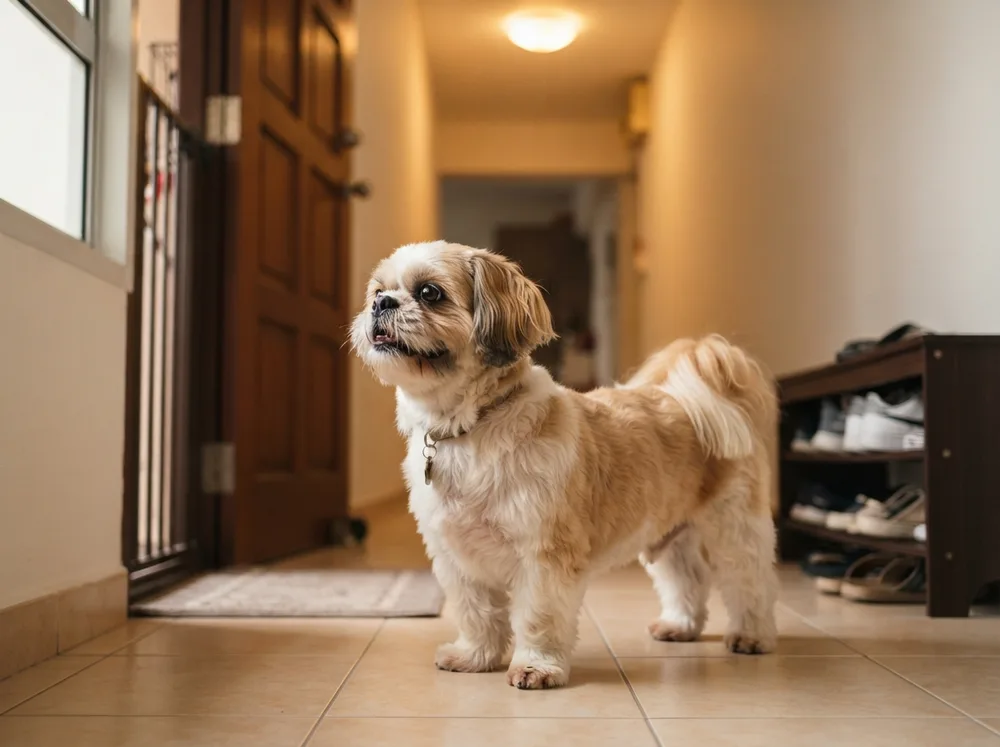
Shih Tzus are moderate alert barkers, not constant ones. In a survey of 2,749 Shih Tzu owners, 78% said their dog barks only when something triggers it, 19% said not at all, and 3% reported non-stop barking. In an HDB flat the triggers just arrive more often, so the job is managing the corridor, not silencing the dog.
Honest about the noise, before you commit
How much do Shih Tzus actually bark?
Shih Tzu barking is alert barking: a short, sharp announcement of a doorbell, a footstep or another dog, rather than a running commentary on the afternoon. Your daily bark count therefore tracks the barking triggers around the dog, plus how the household reacts when one lands. The largest owner-reported figures come from a survey of 2,749 Shih Tzu owners: 78% bark only when triggered, 19% barely bark at all, and 3% bark non-stop.
Are Shih Tzus yappy, then? Not by default. That spread is why breed guides contradict each other: one calls the Shih Tzu a quiet dog breed, the next says it barks at everything. Where a puppy lands depends on the triggers its home throws at it and what the household rewards in the first six months.
Why do Shih Tzus bark? Five reasons cover nearly all of it: the watchdog bark at the door, territorial barking at strangers on the landing, demand barking for attention, boredom barking in an empty flat, and separation barking once you leave. Only the last two usually grow into a Shih Tzu barking problem. The rest is a vocal breed doing the job it was bred for, back when the corridors it guarded were in a palace.
78%
Bark only when triggered
19%
Barely bark at all
3%
Bark non-stop
2,749
Owners surveyed
The Singapore trigger map
Triggers, not temperament, set the daily bark count. A Shih Tzu in a quiet landed house and a Shih Tzu on the tenth floor of a Toa Payoh block are the same breed having completely different days. The underlying character barely varies, and what the Shih Tzu is actually like to live with is watchful and people-focused rather than nervy.
Singapore stacks the triggers on top of each other. Lift lobby noise arrives a few metres from your gate, delivery riders turn up at odd hours with rustling bags, renovation drilling starts two floors up on a Tuesday, and void deck dogs bark until yours answers through the window. Log a week of it in your phone notes and the list beside this paragraph is almost always what comes back.
Two triggers get asked about more than the rest. Shih Tzu barking at strangers is plain watchdog instinct, and it softens with early puppy socialisation, ideally inside the socialisation window before about 16 weeks. Barking at other dogs on a walk is usually frustration on a tight lead rather than aggression, and it answers to distance and treats long before it answers to correction.
What sets them off in a flat
- Doorbell barking, knocks, and the gate rattling
- Barking at footsteps and trolley wheels outside
- The lift chime and general lift lobby noise
- Barking at delivery riders and at visitors
- Void deck dogs, answered through the window
- Renovation drilling noise from another floor
- Boredom across a long, empty afternoon
Why does an HDB corridor make barking worse?
An HDB corridor is a shared thoroughfare running past your front door, so a dog that alerts to passers-by collects a fresh trigger every few minutes. Shared walls then carry the result to three neighbours instead of none. The barking is ordinary; the acoustics are not.
Landed housing gives a dog a garden buffer and a gate it glances through occasionally. A flat gives it a metal gate at nose height, opening straight onto everybody's route to the lift. From the dog's side of that gate, every trip to the rubbish chute is an intruder announcing itself.
Trigger management is the whole game in close-quarters living, and condo dog noise follows the same shape. The reassuring half: an alert bark is brief by design, an announcement rather than a siege. The problem in a flat is frequency, and frequency is a sightline and routine problem you can fix in a few weeks.
A corridor is not a hallway. It is a conveyor belt of triggers running past your front door.
Three changes that cut corridor barking
- Block the sightline. A privacy panel or window film on the gate kills the visual trigger before the sound one starts
- Add white noise. A fan or a low radio masks the lift chime and passing footsteps
- Greet and release. Acknowledge the alert once, call the dog away, and pay the dog for coming back to you
Can neighbours complain about barking in an HDB flat?
Yes, and the process is well defined. HDB pet rules require that your dog does not cause a nuisance, and persistent barking or excessive barking counts as one. Nuisance barking is the actual legal category; a brief announcement as someone walks past is not. Complaints escalate from a conversation to mediation, and since March 2025 mediation must happen before any tribunal claim.
There is no decibel threshold anywhere in the HDB dog barking rules. Each case is assessed on its own facts, which in practice means the pattern matters more than the peak: a dog barking for twenty minutes every night at 11pm is a very different case from one announcing the postman.
Read the ladder below as a set of exits rather than a countdown. Almost every case ends at step one or step three. Fees come from the Community Mediation Centre and a Singapore guide to dog barking complaints; the conditions themselves, including the one dog per flat rule, sit in HDB's guidelines on keeping pets and in our own guide to the HDB pet-keeping conditions in detail.
| Step | Who gets involved | What it costs |
|---|---|---|
| 1. A conversation | You and your neighbour, at the door or by note | Free, and where most cases quietly end |
| 2. Grassroots or town council | A grassroots leader or town council staff mediate informally | Free |
| 3. Community Mediation Centre | CMC mediation with a trained volunteer mediator, mandatory before any tribunal claim since March 2025 | Free, whatever the number of sessions |
| 4. Community Disputes Resolution Tribunals | A CDRT order, typically 2 to 6 months from filing | $150 filing fee |
| 5. HDB and AVS enforcement | Breach of the pet-keeping conditions | Up to $4,000 fine for the dog owner |
How do you train a Shih Tzu to bark less?
How to stop a Shih Tzu barking, in order: cut the fuel, teach the quiet cue, then rehearse the real triggers at low volume. Reward the silence and never the bark. The honest barking training timeline is 8 to 12 weeks of consistent training in short daily sessions, and the goal is less alert barking rather than none.
Step one, remove the fuel. Block the gate sightline, mask the corridor with white noise, and get the morning walk and some mental stimulation in before the hours you care about. A daily walk routine plus a food puzzle, a lick mat or a snuffle mat beats any correction, because a tired dog is a quiet dog and a bored Shih Tzu invents triggers when the flat runs out of real ones.
Step two, teach the cue. Speak and quiet training is the standard method: let a bark or two happen, say the quiet command once, then pay the first pause. Humane-society alarm barking guidance suggests five or six repetitions per session, a few short sessions a day. Positive reinforcement of silence outlasts punishment of noise.
Step three, rehearse the trigger. Desensitisation and counter-conditioning handle the rest. Play a doorbell recording at low volume while good things happen, so barking at the doorbell stops predicting a visitor and starts predicting chicken. Raise the volume slowly across weeks.
Step four, use the lesson you already have. Every puppy we place goes home with a free first lesson from an AVS-certified trainer, plus playpen setup on the day. Book it inside the first fortnight while the habits are still soft, not in month four when a neighbour has already knocked.
8–12 wks
Realistic timeline
5–6
Reps per session
2–3
Short sessions a day
0
Shouting, ever
Three fixes that backfire
Never shout at a barking dog. From the dog's side of the room, a raised voice reads as the human joining in, so the volume goes up rather than down. Correction after the fact adds anxiety to a dog that thought it was doing its job, and anxious dogs bark more. None of this is small dog syndrome, a label that blames the dog for a management problem.
Anti-bark collars deserve their own paragraph. The Shih Tzu is a flat-faced breed with a compressed airway, so a device that tightens, sprays or shocks around the throat is a poor trade in a tropical climate. They also punish the symptom and leave the trigger untouched, so the barking returns the day the collar comes off.
The advice to simply ignore the barking is half right. Ignore the bark, yes, but only while you are also removing the trigger. The quiet failure mode is accidental reward: opening the door, picking the dog up, or even a firm "no" mid-bark all land as attention. Wait for the pause, then pay for the pause.
What makes barking worse
- Shouting, which the dog hears as backup rather than correction
- Punishing after the fact, which stacks anxiety on top of alert barking
- Anti-bark collars, unsuitable for a brachycephalic breed and aimed at the symptom
- Rewarding by accident: the door opens, the dog gets picked up, the bark worked
- Ignoring the barking while leaving the trigger in place, which just rehearses it
Do Shih Tzus bark when left alone?
Shih Tzu barking when left alone is common, and it is the barking neighbours hear most, because the owner is not home to hear it. Separation barking sounds different from alert barking: it starts within minutes of the door closing, runs on and off for hours, and arrives with pacing or chewing rather than a short announcement and a return to the sofa.
The distinction matters because the fixes point in opposite directions. Alert barking is a trigger problem you manage at the gate. Separation anxiety is an attachment problem you solve with leave alone training and gradually longer absences, and blocking triggers without touching the attachment can make it worse.
Shih Tzu barking at night is a different puzzle again. In a young puppy it is usually a toilet need or protest at sleeping alone in an unfamiliar flat, both of which pass. In an adult it is more often something outside the window, so treat the sound rather than the dog.
A cheap pet camera settles all of this in one afternoon. Crying that stops after five minutes is protest; crying that runs for an hour is worth treating while it is still a training problem and not a complaint. The realistic home alone hours and the build-up plan are in our guide to how long a Shih Tzu can be left alone.
| Signal | Alert barking | Separation barking |
|---|---|---|
| When it starts | The instant a trigger happens | Within minutes of you leaving |
| How long it runs | Seconds, then it stops | On and off for as long as you are out |
| What else you see | Ears up, then back to the sofa | Pacing, drooling, chewing, indoor accidents |
| What actually fixes it | Sightlines, a quiet cue, enrichment toys | Gradual absence training, not trigger control |
Which small dogs bark less than a Shih Tzu?
The Shih Tzu noise level sits mid-table among the toy breeds Singapore families cross-shop off the HDB approved small breed list. Companion dogs bred to sit with people generally bark less than spitz-type alarm dogs and small working terriers. Breed averages are weak predictors, though, and the individual dog plus the first six months of training beat the chart nearly every time.
The shape of the ranking is well agreed even where the exact order is not. The quiet end holds the placid companion lapdogs; the loud end holds the spitz types and terriers bred to raise an alarm and rewarded for it for centuries. The Shih Tzu sits in between, watchful but brief, which is unsurprising for a dog that was a palace watchdog long before it was a flat living companion.
Buyers usually arrive wanting the quietest HDB approved breeds, or a straight Shih Tzu vs Maltese barking verdict. The honest answer disappoints: no toy breed is a guaranteed quiet dog breed, and the variation inside any breed is wider than the gap between two of them. We have placed 30+ Shih Tzus with Singapore families, and the deciding factor has never been a breed chart. It is whether the household manages triggers from week one.
Roughly where the Shih Tzu sits
- Quieter end: the calm, placid companion lapdogs
- Mid-table: the Shih Tzu, watchful but brief
- Louder end: spitz types bred to raise alarms
- Louder end: small terriers bred to work
- Stronger predictor than breed: the first six months
- Wildcard: how many triggers your floor throws
What owners actually report
Owner forums describe a range rather than a rule. In communities like r/shihtzu, Shih Tzu owners report everything from a dog that has never really barked to one that announces every lift arrival on the floor. That matches the survey: 78% trigger-only, 19% barely at all, 3% non-stop.
Three patterns repeat across those threads. We frame them as community-reported because that is exactly what they are: our own records tell us who we placed a puppy with, not how a stranger's dog behaves at 11pm on a Tuesday.
The happy write-ups rarely credit a gadget. They credit a routine that was boring, daily, and held for longer than it felt necessary to hold it.
Owners rarely describe a quiet breed or a loud breed. They describe a quiet routine or a loud one.
The three patterns owners describe
- Barking tracks routine: a walked, mentally worked dog announces far less
- Barking tracks attention: a dog that once got a reaction keeps asking for one
- Barking tracks the door: in a flat, the front gate is the single biggest trigger
The honest verdict: who should skip this breed
Barking should put you off a Shih Tzu in one situation only: when silence is non-negotiable and nobody is home to manage the triggers. Everything else in the table below is workable with a gate panel, a quiet cue, and a couple of months of patience.
Grooming-readiness is the formal gate we run at our AVS licensed pet shop before price ever comes up: daily brushing, plus a professional groom every 4 to 6 weeks, for the dog's whole life. Noise belongs in the same conversation. Being an HDB approved dog is a licence to keep one, not a personality profile, so we say the barking line out loud before anyone commits. We would rather talk you out of the wrong breed than sell you the wrong dog.
For a first-time owner the reassuring part is that the breed's other headline traits hold up. It is friendly with children, good with the elderly, and a genuine apartment living dog, and the stubborn streak shows up in toilet training far more than in noise. Families usually ask about how Shih Tzus do with children and seniors next.
Still weighing it up? WhatsApp us your floor, your hours, and how close your neighbours really are, and you will get a straight answer, including "not this breed" when that is the truth. When you are ready, have a look at the Shih Tzu puppies we place.
| Your situation | The honest verdict |
|---|---|
| Someone home most days, easy-going neighbours | Good fit. Block the gate sightline and you will barely notice it |
| Hybrid work, solid walls, willing to train | Good fit, with 8 to 12 weeks of quiet-cue practice up front |
| Out 12 hours a day with no midday cover | Risky. Separation barking is the likely outcome, and the neighbours hear it before you do |
| Silence behind your walls is non-negotiable | Wrong breed. Alert barking is trainable, not removable |
| A previous dog already drew a noise complaint | Talk to us first. The trigger setup matters more than the breed does |
Keep exploring
Frequently asked questions
Do Shih Tzus bark a lot compared with other small dogs?
Are Shih Tzus noisy? Less than the yappy small dog reputation suggests. They are moderate alert barkers and sit mid-table among small companion breeds: in a survey of 2,749 owners, 78% said their Shih Tzu barks only when something triggers it.
Why does my Shih Tzu bark at the door and the corridor?
Because an HDB corridor delivers a new trigger every few minutes and your gate sits right at nose height. Footsteps, the lift chime, trolley wheels and delivery riders all count. Block the sightline with a panel or window film, add white noise, and train a quiet cue.
Can neighbours complain about my dog barking in an HDB flat?
Yes. HDB pet rules require that your dog does not cause a nuisance, and persistent or excessive barking qualifies. Occasional barking at a passer-by does not. Complaints go neighbour, then grassroots leader or town council, then free mediation at the Community Mediation Centre, then the CDRT at a $150 filing fee.
How long does it take to train a Shih Tzu to bark less?
Plan for 8 to 12 weeks of short daily sessions rather than a weekend. The first step most advice skips is removing the trigger. After that: five or six repetitions per session, two or three sessions a day, and trigger rehearsal at gradually rising volume.
Do Shih Tzus bark when left home alone?
Some do, and it is the barking neighbours notice most. Separation barking starts minutes after you leave and runs on and off, often with pacing or chewing. A pet camera tells you whether it stops after five minutes, which is protest, or lasts an hour, which needs treating early.
Are anti-bark collars OK for a Shih Tzu?
We would not use one. The Shih Tzu is a flat-faced breed with a compressed airway, so a collar that tightens, sprays or shocks around the throat is a poor trade in Singapore heat. It also punishes the symptom and leaves the trigger untouched, so the barking returns.
Is a Shih Tzu quiet enough for HDB living?
For most households, yes. It is an HDB approved dog with a brief alert bark rather than a habitual one. The households that struggle are the ones where nobody is home to manage triggers all day, or where any barking at all is unacceptable behind shared walls.
Meet your Shih Tzu
Come say hello at Balestier
2 Balestier Road #01-701, Singapore 320002 · Weekdays 12pm–6pm · Weekends 10am–6pm. Or message us first: tell us about your home and routine, and we'll tell you honestly if a Shih Tzu fits.
Worried about the neighbours?
Tell us your floor, your hours and how close the corridor runs, and we will tell you honestly whether this breed suits the flat.
Read the HDB guide