Community & culture
What Shih Tzu Means in Chinese the Lion Dog
Shih Tzu is written 獅子狗 in Chinese and it means lion dog. Three names, two rival spelling systems, a Tibetan beginning, five centuries of Chinese palace history, and an honest answer about what all of it is worth to a Singapore family today.
Nelson and Kim, Curious Tails · AVS licence AS24J00046
What does Shih Tzu mean in Chinese?
Shih Tzu comes from 獅子狗 (simplified 狮子狗, pinyin shīzi gǒu), meaning lion dog. The English spelling romanises only 獅子 (shīzi), the ordinary Mandarin word for lion. In modern Mandarin the breed is usually called 西施犬 (Xī Shī quǎn), the Xi Shi dog, after a famous beauty of ancient China.
獅子狗 shīzi gǒu · the lion dog
What does Shih Tzu mean in Chinese?
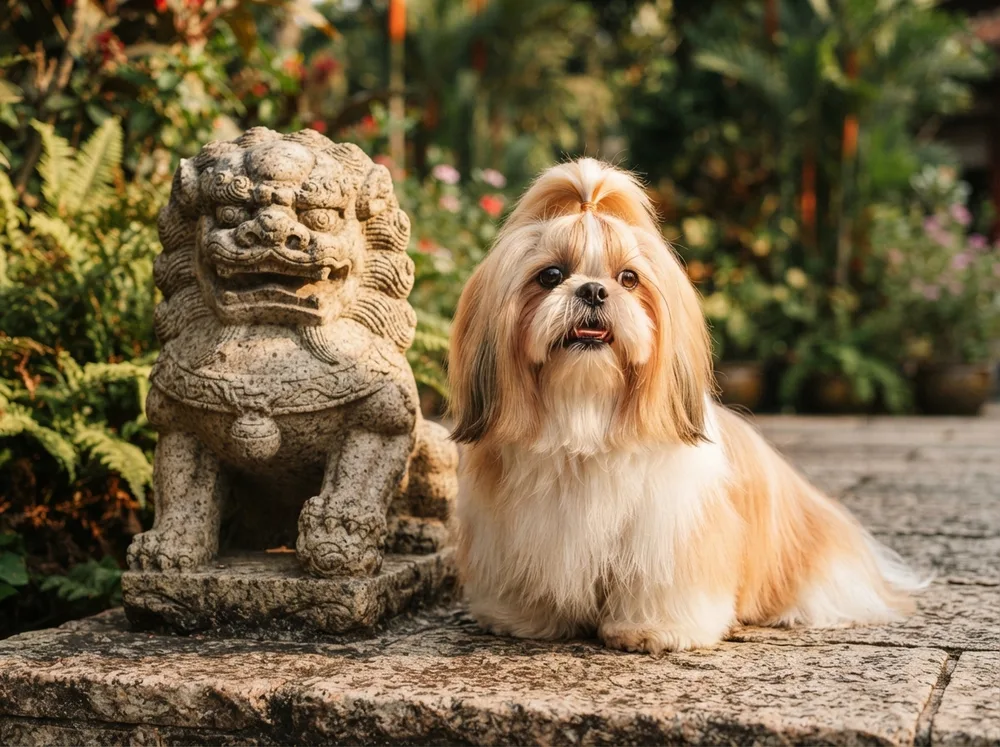
Shih Tzu is the English name for the dog written 獅子狗 in traditional Chinese characters and 狮子狗 in simplified, pinyin shīzi gǒu. Those characters read as lion, a noun suffix, and dog, which together mean lion dog. The name is descriptive rather than poetic: the breed was developed to resemble the stone lions that sit at temple and palace doors.
Here is the part almost every page gets wrong. "Shih Tzu" romanises only the first two characters, 獅子 (shīzi), which is simply the Mandarin word for lion. The full Chinese name adds 狗 (gǒu), dog. So the English breed name literally says lion, while the Chinese name it was shortened from says lion dog. Wikipedia's entry traces the spelling to the Wade-Giles romanisation of 獅子, and that one detail explains most of the confusion around it.
The characters, one at a time
- 獅 (shī): lion
- 子 (zi): a noun suffix here, not a separate word
- 狗 (gǒu): dog
- 獅子狗 (shīzi gǒu): lion dog. Simplified 狮子狗
The three names, side by side
A Shih Tzu answers to three Chinese names, and which one you meet depends on where you are reading. 獅子狗 is the old descriptive name and the source of the English spelling. 西施犬 (Xī Shī quǎn) is the modern standard one, and it is what the Cambridge Dictionary lists alongside 狮子狗. 菊花狗, chrysanthemum dog, is a nickname about the coat.
Singapore print and clinic paperwork use simplified Chinese characters, so expect 狮子狗 rather than the traditional 獅子狗. The two scripts say exactly the same word. Cambridge even glosses the breed in English as the Chinese Lion Dog, which is the closest an English dictionary gets to the original.
| Name | Pinyin | Literally | Where you meet it |
|---|---|---|---|
| 獅子狗 (simplified 狮子狗) | shīzi gǒu | Lion dog | Older texts and history writing; the source of the English name |
| 西施犬 | Xī Shī quǎn | Xi Shi dog | Modern standard Mandarin, dictionaries, clinic forms |
| 西施 | Xī Shī | Xi Shi | The everyday short form, in conversation |
| 菊花狗 | júhuā gǒu | Chrysanthemum dog | Affectionate nickname, coined in England in the 1930s |
Why is it spelled Shih Tzu and not Shizi?
The spelling is a fossil. Shih Tzu is Wade-Giles, the romanisation system English speakers used for Chinese before Hanyu Pinyin became the international standard. Wade-Giles writes the lion word as shih-tzu; pinyin writes the identical sound as shīzi, or shizi gou for the full name once you drop the tone marks. Nothing about the dog changed, only the spelling convention around it.
The breed was registered in the West under the old spelling in the 1930s, decades before pinyin arrived, so the old spelling stuck. English does this constantly. Peking became Beijing, but Peking duck stayed on the menu. Tsingtao is still Tsingtao on the beer label even though the city is Qingdao. A long-running thread of linguists picking the spelling apart reaches the same conclusion: if the breed were named today, it would be sold as the Shizi.
Wade-Giles to pinyin, quick conversions
- shih tzu becomes shīzi (lion)
- Peking becomes Beijing
- Tsingtao becomes Qingdao
- Tz'u Hsi becomes Cixi (the Empress Dowager)
- Lhasa is Tibetan, so neither system applies
Does tzu mean dog? No, and the difference matters
Tzu does not mean dog. It is the second half of 獅子 (shīzi), the everyday Mandarin word for lion, where 子 works as a noun suffix rather than as a word in its own right. On its own 子 does mean child, which is where the confusion starts, but nobody hearing 獅子 thinks "lion child". They think lion.
The word for dog is 狗 (gǒu) in speech, or 犬 (quǎn) in formal and written Chinese, which is why the modern breed name 西施犬 ends the way it does. You will still find "tzu means dog" repeated on breed sites, in dog-name lists, and on at least two pages currently ranking for this exact question. It is wrong, and it is worth getting right, because it is the difference between calling your dog a lion and calling it a lion dog.
Shih Tzu, on its own, says lion. The dog is the character that got left behind in the English spelling.
How do you actually pronounce it?
How to pronounce Shih Tzu is one of the most-searched things about the breed, and the honest answer is that English has settled on two versions, neither of which is the Mandarin one. British dictionaries give SHEE-tsoo. The American Kennel Club teaches SHEED-zoo. Both are accepted, and groomers, vets and show handlers use them interchangeably without anyone blinking.
The Mandarin sound is different again. 獅子 lands closer to shrr-dz, with a high level first tone on shī and a light unstressed zi. No English respelling captures it exactly, and that is fine. Say it the way the people around you say it, and know what it means underneath.
| Version | Sounds like | Used by |
|---|---|---|
| UK English | SHEE-tsoo | British dictionaries, most owners here |
| US English | SHEED-zoo | The American Kennel Club and US breed press |
| Mandarin 獅子 (shīzi) | shrr-dz, high level tone | Anyone reading the characters aloud |
| Common misspellings | shitzu, shihtzu, shih-tzu | Search boxes everywhere |
西施犬: the beauty the breed is named after
西施犬 (Xī Shī quǎn) means Xi Shi dog. Xi Shi 西施 lived in the 5th century BC and is counted among the Four Great Beauties, 四大美女, of ancient China. The legend says fish forgot how to swim and sank when she leaned over the water to look at them.
Naming a flat-faced, floor-length lapdog after the most beautiful woman in Chinese history is not a description. It is a compliment, and a fairly funny one. Nobody has firmly documented when 西施犬 overtook 獅子狗 as the everyday name either; Wiktionary's own etymology note flags the shift as needing a source, so treat any confident date you read elsewhere with suspicion.
Two names, two different compliments
獅子狗 says the dog looks like a temple lion: brave, guarding, auspicious. 西施犬 says it is beautiful. Both are flattery. Neither is an accurate description of an animal that will follow you to the bathroom and then sit on your feet.
獅子狗 and the stone lions at the door
The lions the breed was bred to echo are not real lions. They are 石獅 (shíshī), stone lions, also called 瑞獅 (ruìshī), auspicious lions, and they stand in pairs at the entrances of temples, palaces, government buildings and the houses of the wealthy. If you have walked the temple gates along Telok Ayer Street, you have already met a pair.
The pair has a fixed grammar. The male rests a paw on an embroidered ball, 繡球 (xiùqiú), and guards the building itself. The female rests a paw on a cub and protects the people inside. Seen from outside looking in, the male stands on the right and the female on the left. Chinese guardian lions come out of Chinese Buddhism, and the pair is read as yin and yang.
How to read a pair of stone lions
- Male: paw on an embroidered ball, 繡球 (xiùqiú), guards the structure
- Female: paw on a cub, protects the people inside
- From outside looking in: male on the right, female on the left
- Names: 石獅 (shíshī) stone lion, 瑞獅 (ruìshī) auspicious lion
- Called foo dogs in English, though they are not dogs at all
Why breed a small dog to look like a lion at all?
No lion has ever lived wild in China. The lion arrived as an idea, through Buddhism, where it is sacred and protective, and where legend has the Buddha arriving on the back of one. Craftsmen carving guardian lions were working from description rather than observation, which is why the statues look less like an animal and more like a stylised, curly-maned, wide-headed creature.
That creature is more or less what a Shih Tzu looks like. A dog bred to resemble the statue was a living version of a protective symbol, kept where the symbol mattered most. The lion cues survive in the modern breed: the mane-like ruff around the neck, the broad round head, the tail carried high over the back. What did not survive was anything lion-like about the personality, which is a mercy. Our guide to what a Shih Tzu is actually like to live with covers the gap between the symbol and the sofa.
A Shih Tzu does not look like a lion. It looks like a Chinese sculptor's idea of one, which is a very different job.
From Tibet to the Chinese court: the short version
The breed starts in Tibet, not China. Small dogs kept at Tibetan monasteries were sent to Chinese courts as gifts, and the Shih Tzu as we know it was then developed in China from crosses with the Lhasa Apso and the Pekingese. Both halves of that sentence matter, because "Chinese breed" and "Tibetan breed" are each about half right.
Once at court, the dogs were court property. Palace eunuchs ran the breeding and were rewarded for producing good ones, and court artists painted the dogs into palace hangings for centuries. The American Kennel Club's breed history puts the arrangement plainly: for years the court refused to sell, trade or give a single one away.
| When | What happened |
|---|---|
| Tibet, before the court | Small monastery dogs, sent to Chinese courts as gifts |
| Yuan, 1271 to 1368 | Court dogs raised inside the palace by eunuchs |
| Ming, 1368 to 1644 | Painted into palace hangings; never sold, traded or given away |
| Qing, 1636 to 1911 | Cixi's breeding programme, dispersed after her death in 1908 |
| 1928 to 1952 | 13 dogs leave China for England and Norway and found the modern breed |
Empress Dowager Cixi's palace kennels
Cixi held power in China from 1861 to 1908, and older English books spell her name Tz'u Hsi, which is the same Wade-Giles system that gave us Shih Tzu. She kept kennels of Pugs and Pekingese, and the Dalai Lama is said to have gifted her a breeding pair of Shih Tzu-type dogs in the 1860s.
From that pair she built a dedicated breeding programme, run by palace eunuchs, with the dogs housed and bred inside the palace itself. When she died in 1908 the programme died with her. The dogs were dispersed, and within a generation the breed had become genuinely rare in its own country.
Why the palace history nearly ended the breed
Court dogs had no life outside the court, so when the court went, they went too. The American Kennel Club records that after 1949 the breed was wiped out in China because of its association with wealth. Every Shih Tzu alive today descends from the handful that had already left.
How 13 dogs became every Shih Tzu alive today
Thirteen. That is the number of dogs the entire modern breed traces back to, taken out of China between 1928 and 1952, plus a single Pekingese cross added in 1952. Lady Brownrigg, an Englishwoman living in China, brought the first two to England in 1928.
The American Shih Tzu Club formed in 1963 and the breed entered the American Kennel Club stud book in 1969, which is startlingly recent for a dog with centuries of court history behind it. A founding group that narrow is also why honest health screening matters more in this breed than the marketing usually admits. We do not trade on paper certification. We place vet-checked, microchipped puppies with vaccination records and breed identification, and we say what we know and what we do not.
13
Founding dogs, 1928 to 1952
1928
First two reach England
1969
Entered the AKC stud book
1949
Breed lost inside China
菊花狗: the chrysanthemum face, explained by the breed standard
菊花狗 means chrysanthemum dog, and it describes one very specific thing. The hair on the muzzle grows outwards in every direction, so the face reads as a flower rather than a snout. The Kennel Club breed standard writes it into the official wording, calling for hair growing upwards on the muzzle for a "chrysanthemum-like" effect, with a good beard and whiskers.
The nickname was coined in England in the 1930s rather than in China, which makes it the one name on this page that is not Chinese at all. The same standard describes the breed as sturdy, with a distinctly arrogant carriage. That is the politest available way of saying your dog will look at you like you work for it.
What the standard actually calls for
- Hair growing upwards on the muzzle: the chrysanthemum effect
- A good beard and whiskers
- Sturdy, abundantly but not excessively coated
- Height not more than 27 cm at the withers
- Ideal weight 4.5 to 7.5 kg
Is the Shih Tzu Chinese, Tibetan, or Japanese?
Tibetan in ancestry, Chinese in development, and not Japanese at all. That is the whole answer, and it is worth stating flatly because "shih tzu meaning in japanese" is a query people genuinely run every month.
Japanese writes the breed as シーズー (Shīzū), entirely in katakana. Katakana is the script Japanese reserves for foreign loanwords, so the spelling itself is the proof: the name arrived from outside. Google's own breed panel lists the origin as China and Tibet, and the Chinese names on this page all predate any Japanese one.
| Claim | Verdict | Why |
|---|---|---|
| Tibetan breed | Half right | The ancestry traces to small Tibetan monastery dogs |
| Chinese breed | Half right | Developed at the Chinese court from Lhasa Apso and Pekingese crosses |
| Japanese breed | No | Written シーズー in katakana, the script used for foreign loanwords |
| English breed | No | England named it the chrysanthemum dog and kept it alive, nothing more |
The lion dog in the Lion City
Singapore's Chinese nickname is 獅城 (simplified 狮城), shīchéng, Lion City. The 獅 in 獅城 is the same character as the 獅 in 獅子狗. A city named for a lion, and a dog named for a lion, sharing one character and one idea.
Neither lion is real. Singapura comes from Sanskrit siṃha, lion, and pura, city, after a sighting on the island in 1299 that almost certainly was not a lion. The Shih Tzu, meanwhile, was bred to resemble a statue of an animal that never lived in China. Both are symbols people chose and then built things around, which is quite possibly the most Singaporean thing about the breed, and it is why every page on this site about the Shih Tzu in Singapore calls it the lion dog and means it.
A lion city and a lion dog, sharing one character, 獅, and one animal that neither of them ever actually had.
獅
Shared by 獅城 and 獅子狗
1299
The sighting that named the island
siṃha
Sanskrit for lion
Item 48
Shih Tzu on the HDB approved list
What Chinese-speaking families here actually call the breed
The Shih Tzu Chinese name you meet in print is 西施犬. It is what dictionaries list, what Chinese-language breed listings use, and what tends to appear on a clinic form. In conversation it usually gets shortened to 西施, while 獅子狗 is understood by everyone but reads as the older, more literary word, roughly the way "hound" reads in English.
One practical thing is worth knowing: none of it has legal standing. HDB's approved small-breed list and the AVS dog licence are both issued in English, and the Shih Tzu appears on that list as item 48. Whatever the family calls the dog at home, the paperwork says Shih Tzu.
Honestly, the language question comes up more than you would expect. What we usually do is ask who in the household is going to hold the brush every day, and then talk to that person, because the grooming answer is the one that decides whether a Shih Tzu suits the home at all. Sometimes that person is a grandparent who would rather have the whole conversation in Mandarin. That is genuinely fine.
Worth knowing at a vet counter
- 西施犬 (Xī Shī quǎn): the breed name on forms and listings
- 西施 (Xī Shī): the everyday short form
- 西施狗 (Xī Shī gǒu): the same name using the spoken word for dog
- 獅子狗 (shīzi gǒu): understood, but reads as the older word
- 狗 (gǒu) is dog in speech; 犬 (quǎn) is the formal written form
- The HDB list and the AVS licence are both in English
Naming a Shih Tzu: characters that suit a lion dog
Naming a lion dog in Chinese opens a whole extra set of options, and the good ones tend to be short. Two syllables, ideally with a repeated sound, because that is what a dog can actually pick out across a room. Doubling a character is the standard trick: 金金 lands better than 金 on its own.
Below are six that suit this breed rather than any dog. Pick for the coat colour, for the lion heritage, or for the character you can already see at eight weeks old. If you would rather browse a longer list in both languages, we keep name ideas for a Shih Tzu puppy on a separate page.
| Name | Pinyin | Meaning | Why it fits |
|---|---|---|---|
| 小獅 | Xiǎo Shī | Little lion | The heritage, said out loud, every single day |
| 阿獅 | Ā Shī | Lion, informally | The 阿 prefix is warm and casual, like adding a "little" |
| 金金 | Jīnjīn | Gold | For a gold and white coat, the most common colour we place |
| 墨墨 | Mòmò | Ink | For a solid black Shih Tzu |
| 寶寶 | Bǎobao | Treasure | Which is exactly what the palace dogs were |
| 福福 | Fúfu | Good fortune | Pairs neatly with the auspicious lion, 瑞獅 |
Imperial is a palace word, not a size
The palace history on this page is real. "Imperial Shih Tzu" is not. There is no imperial tier, no mini tier and no teacup tier in any breed standard, in any of the Chinese names for this breed, or in any court record. Those words are modern sales vocabulary borrowed from a dynasty, because heritage sells.
We refuse the label outright, and we say so before anyone talks price. Deliberately breeding undersized dogs, or selling the smallest puppy in a litter as "imperial", trades a dog's health for a size word, and a premium price attached to that word is a warning sign rather than a mark of quality. The full explanation of why we refuse the imperial label sits on its own page.
The plain rule
A size word borrowed from a dynasty is a marketing word. The Chinese names for this breed describe a lion, a beauty and a flower. Not one of them describes a size.
What the palace history does not change
The lion mane is the grooming bill. A Shih Tzu grows hair rather than fur, continuously, like human hair, so the coat needs daily brushing to stay out of a mat plus a professional groom every 4 to 6 weeks for the dog's whole life. In Singapore that runs $75 to $120 a session, roughly $900 to $1,400 a year, every year.
The flat face that reads as a lion is also a heat profile. A short muzzle moves less air, this climate does not forgive that, and walks end up planned around the hour rather than the mood. The legal side is simpler but no more optional: the Shih Tzu is HDB approved, item 48 on the official list, one approved dog per flat, with a mandatory AVS licence and a free AVS pet ownership course for first-time owners. Every Shih Tzu Singapore families keep in a flat lives under those same rules, heritage or not.
Those are the two questions we ask before recommending this breed to anyone. Are you ready for the grooming, and do you understand the flat face. The heritage is lovely. It grooms nothing.
4 to 6 wks
Between professional grooms
$75 to $120
Per grooming session
$900 to $1,400
Grooming, every year
Item 48
HDB approved small-breed list
Bringing a lion dog home in Singapore
30+ Shih Tzus placed with Singapore families, at $3,888–$4,888 all-in. That covers the vet health check, vaccinations, microchip and breed identification, the starter kit, free home delivery and playpen setup, a free training lesson, and the first professional groom, because grooming is the part of this breed people most underestimate. Licensing paperwork is completed at the point of purchase.
Message us and the first thing we will ask about is the grooming, not your budget. We would rather talk you out of the wrong breed than sell you the wrong dog. Our licence is AS24J00046, and you can check it yourself on the AVS public registry of licensed pet shops before you say a word to us.
Included with every Shih Tzu
- Vet health check, vaccinations, microchip, breed identification
- Starter kit: 30 items, $533 itemised
- Free home delivery and playpen setup
- Free first training lesson with an AVS-certified trainer
- First professional groom included; licensing done at purchase
Keep exploring
Frequently asked questions
What does Shih Tzu mean in Chinese?
Shih Tzu comes from 獅子狗 (simplified 狮子狗, pinyin shīzi gǒu), which means lion dog. The English spelling romanises only the first part, 獅子 (shīzi), the ordinary Mandarin word for lion. The breed was developed at the Chinese court to resemble the stone guardian lions at temple and palace doors.
How do you write Shih Tzu in Chinese characters?
Two ways are both correct. The descriptive name is 獅子狗 in traditional characters and 狮子狗 in simplified. The modern standard name is 西施犬 (Xī Shī quǎn), the Xi Shi dog, which is what you will usually see on a clinic form or a Chinese-language breed listing.
Does tzu mean dog in Chinese?
No. 獅子 (shīzi) is simply the Mandarin word for lion, and the 子 inside it is a noun suffix rather than a separate word for dog. The word for dog is 狗 (gǒu), or 犬 (quǎn) in formal writing. So Shih Tzu on its own literally says lion, while the full name 獅子狗 says lion dog.
Why is the breed called 西施犬 in modern Chinese?
西施犬 means Xi Shi dog, after Xi Shi, one of the Four Great Beauties of ancient China. It is a compliment about the breed rather than a description of it. The name has largely replaced 獅子狗 in everyday Mandarin, though both are still understood.
Why is it spelled Shih Tzu instead of Shizi?
Because the name entered English through Wade-Giles, the romanisation system used before Hanyu Pinyin became standard. Wade-Giles writes the sound as shih-tzu; pinyin writes the same sound as shīzi. The breed was already registered under the old spelling, in the same way Peking became Beijing but Peking duck did not.
Is the Shih Tzu a Chinese or a Tibetan breed?
Both, in sequence. The ancestry is Tibetan, from the small monastery dogs of Tibet, and the breed as we know it was developed at the Chinese imperial court from Lhasa Apso and Pekingese crosses. Google's own breed panel lists the origin as China and Tibet. It is not a Japanese breed.
Is an imperial Shih Tzu a real thing in Chinese?
No. The palace history is genuine, but imperial, mini and teacup are modern sales labels with no place in any breed standard and no Chinese equivalent. Deliberately breeding undersized dogs trades health for a size word. We refuse the label and will not sell on it.
Does the lion dog heritage change how much work a Shih Tzu is in Singapore?
Not at all. That lion-like coat needs daily brushing and a professional groom every 4 to 6 weeks at $75 to $120 a session, roughly $900 to $1,400 a year for the dog's life. The Shih Tzu is HDB approved as item 48 on the official list and needs a mandatory AVS licence, exactly like any other approved small breed.
Meet your Shih Tzu
Come say hello at Balestier
2 Balestier Road #01-701, Singapore 320002 · Weekdays 12pm–6pm · Weekends 10am–6pm. Or message us first: tell us about your home and routine, and we'll tell you honestly if a Shih Tzu fits.
Still just here for the characters?
Completely fine. Take the names, take the history, come back whenever. If you do want a lion dog of your own one day, the grooming question is the one to answer first.
Read the grooming truth