Breed comparison
Pekingese vs Shih Tzu: which lion dog fits your flat?
Two flat-faced Chinese lion dogs, both HDB-approved, endlessly mixed up. Here is the honest pekingese vs shih tzu comparison for Singapore, plus the Pekingese Shih Tzu mix (Shinese), from Curious Tails, an AVS licensed shop.
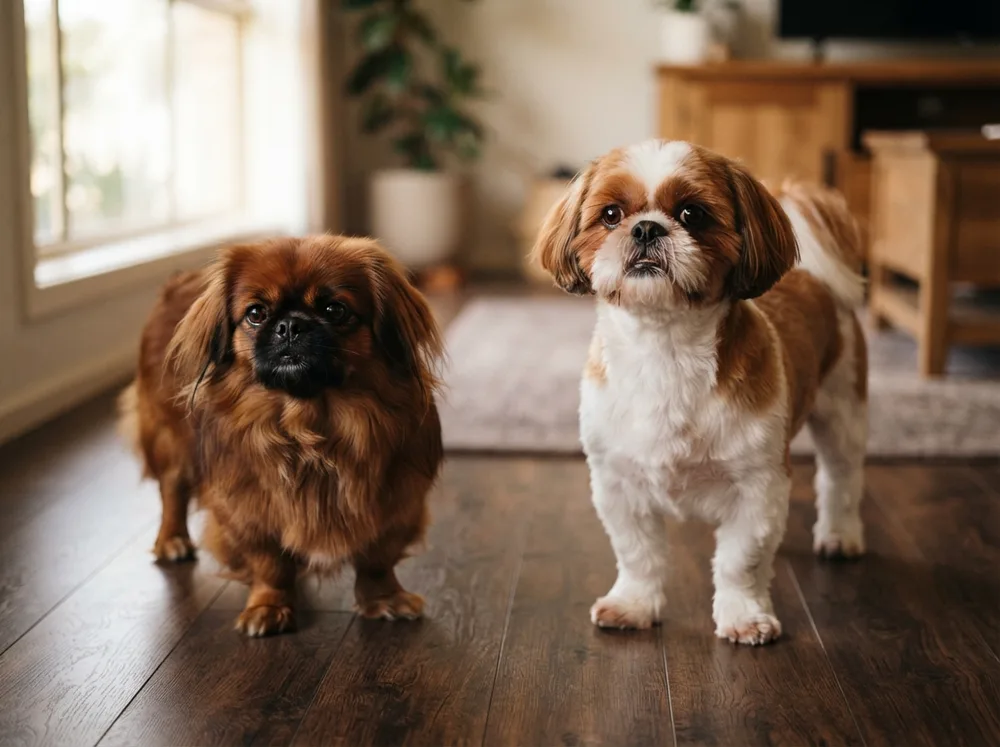
What is the difference between a Pekingese and a Shih Tzu?
The Pekingese is a heavier-boned, independent, heavy-shedding double-coated companion; the Shih Tzu is a sturdier-tempered, outgoing, low-shedding long-haired one. Both are flat-faced Chinese lion dogs on HDB's approved small-breed list, and their cross is called the Shinese (Peke-Tzu).
Two lion dogs, compared honestly for flat living
Two lion dogs, one imperial family tree
The Pekingese and the Shih Tzu are both small Chinese companion breeds bred for the imperial court, which is exactly why Singaporeans mix them up at the dog run. The Pekingese was the palace "sleeve dog", carried in the sleeves of Forbidden City courtiers; the Shih Tzu (獅子狗, "lion dog") was bred down from Tibetan lion dogs with Lhasa Apso ancestry.
Same royal backstory, same flat face, very different daily life. If your lookalike confusion is actually with the Lhasa, read our Shih Tzu vs Lhasa Apso comparison; the Lhasa is the true sibling-lookalike.
This page compares the two honestly for a Singapore flat: coat, temperament, health, HDB rules, grooming cost, and the Pekingese Shih Tzu mix.
The confusion, in one card
- Both: small, flat-faced, Chinese imperial lapdogs
- Pekingese: front-heavy build, rolling gait, mane-like coat
- Shih Tzu: square, sturdy build, long silky hair
- Both: on HDB’s approved small-breed list
- The cross: Shinese, also called Peke-Tzu
How to tell them apart at a glance
Look at the face first. The Pekingese muzzle is typically flatter and more wrinkled, with a wide "peke nose" set between the eyes; the Shih Tzu wears the famous chrysanthemum face, hair radiating outward from a slightly longer muzzle.
Then watch them walk. The Pekingese is front-heavy with slightly bowed front legs, so it moves with a distinctive rolling gait; the Shih Tzu is square and sturdy and simply trots.
The coat settles any remaining doubt. A Pekingese carries a coarse double coat with a lion-mane ruff over a thick undercoat; a Shih Tzu grows long, silky hair continuously, more like human hair than fur.
| Trait | Pekingese | Shih Tzu |
|---|---|---|
| Adult size | Up to about 6.4 kg, heavier-boned than the number suggests | About 4 to 7.5 kg, 20 to 28 cm at the shoulder |
| Coat | Double coat: coarse outer coat, thick undercoat, mane ruff | Long silky hair, grows continuously, hair not fur |
| Shedding | Heavy, year-round | Low-shedding, but mats without daily brushing |
| Temperament | Independent, aloof with strangers, one-person watchdog | Outgoing, friendly with children and the elderly |
| Grooming cost (SG) | Heavy brushing plus shedding management | $75 to $120 per salon session, every 4 to 6 weeks |
| HDB status | On the approved small-breed list | On the approved list, item 48 |
Coat and shedding: fur versus hair
A Pekingese coat is fur: a double coat that sheds heavily all year, with seasonal blowouts on top. Budget for a good vacuum and hair on every cushion of your flat.
A Shih Tzu coat is hair: low-shedding, which is how the breed is sold to allergy-conscious HDB households. Honestly, though, "low-shedding" is the sales pitch; the truthful phrase is high-maintenance coat. That hair grows continuously, mats fast in our humidity, and demands daily brushing.
So the real trade-off is vacuuming versus brushing. Neither breed is zero-work; you are only choosing where the work goes.
You are not buying less grooming with a Shih Tzu. You are buying a daily brush and a groomer on retainer for 12+ years.
The grooming bill, in Singapore dollars
A professional Shih Tzu groom in Singapore costs about $75 to $120 a session, every 4 to 6 weeks, which works out to roughly $900 to $1,400 a year; a Singapore grooming price survey puts small-breed salon grooms in the same band. That is the number no overseas comparison article gives you.
The Pekingese swaps some of that salon bill for home labour: heavy brushing several times a week, dematting the ruff, and constant shedding management, with periodic professional tidy-ups.
Grooming-readiness is the first question we ask before recommending a Shih Tzu at all. If a 4-to-6-weekly grooming budget is not realistic, we say so before any price talk.
$75–120
Per salon session (SG)
4–6 wks
Groom cadence, Shih Tzu
$900–1,400
Per year, Shih Tzu coat
Daily
Brushing, both breeds
Temperament: the aloof emperor versus the sociable courtier
The Pekingese behaves like it remembers the palace. Owners consistently describe an independent, dignified dog that bonds hard with one person, stays wary of strangers, and alert-barks like a tiny watchdog; a recurring theme in owner forums is a Peke that tolerates guests rather than greets them.
The Shih Tzu is the sociable courtier: outgoing, affectionate, and genuinely friendly with children and elderly family members, which is why we recommend it to HDB households wanting an affectionate, sturdy companion.
Training is a slog with both; these are stubborn, charming breeds, and the Pekingese is generally the more wilful of the two. Owner threads also warn that toilet-training either breed takes longer than the internet promises; patience is part of the price, and every placement of ours includes a free AVS-certified training lesson.
Who suits which, honestly
- Young family with kids: Shih Tzu; sturdier temper, friendlier with children.
- Retiree wanting one loyal shadow: a Pekingese fits, if the shedding is accepted.
- First-time owner: Shih Tzu; more forgiving, easier to socialise.
- Working couple out 9+ hours daily: the Peke copes alone better, but honestly, neither breed loves long empty days.
Two flat faces in a tropical city: the health talk
Both breeds are brachycephalic, meaning the short muzzle compresses the airway (the BOAS spectrum) and cuts heat tolerance, which matters enormously in 32-degree humidity. The Pekingese face is typically the flatter of the two, so its heat and breathing margin is usually narrower; the vet-charity health notes for the Shih Tzu cover the same airway and eye risks on the Shih Tzu side.
Both also carry prominent eyes: dry eye, corneal ulcers, and proptosis risk on trauma, plus tear staining on light coats. A daily face wipe is part of owning either breed.
The flat face is a feature buyers coo at and a health profile they ignore. In Singapore you cannot just "walk him more"; you design around the climate. Walks go early morning or after sunset, the aircon or a fan runs through the afternoon, a cooling mat helps, and midday walks are simply off the menu for both breeds. None of this prevents problems; it reduces risk, and that is the honest framing.
Heat stress is an emergency, for BOTH breeds
- Warning signs: heavy laboured breathing, bright-red gums, wobbling or collapse.
- Act immediately: move to shade or aircon, cool with water, and get to a vet NOW.
- Prevention is risk reduction only: dawn or dusk walks, aircon in the afternoon, never a midday walk.
Size, lifespan and daily exercise
The Shih Tzu stands 20 to 28 cm and weighs about 4 to 7.5 kg. The Pekingese runs up to about 6.4 kg on paper, but it is heavier-boned than the numbers suggest; sources quote anywhere from 3.2 to 6.4 kg.
Lifespans overlap: roughly 10 to 16 years for the Shih Tzu and about 12 to 14 for the Pekingese, so either dog is a decade-plus commitment.
Exercise needs are mercifully low for both. Two short walks in the cool hours plus indoor play suits an HDB flat perfectly, and neither breed will demand a Bukit Timah hike.
4–7.5 kg
Shih Tzu adult weight
~6.4 kg
Pekingese, heavier-boned
10–16 yrs
Typical lifespans
2 short
Walks a day, both
Are both breeds HDB-approved in Singapore?
Yes, both. The Pekingese and the Shih Tzu (item 48) each sit on the roughly 62-breed approved small-breed list under HDB's approved-breed rules, so either can live legally in your flat.
The rules are the same for both: one approved dog per flat, a mandatory AVS dog licence, and a fine of up to $4,000 for keeping a non-approved dog. First-time owners also complete the AVS pet ownership course before licensing.
One more rule matters for the next section: a cross of two approved breeds also counts as approved. We handle the licensing paperwork at purchase, so our buyers never touch the forms.
HDB rules, both breeds
- Both breeds on the approved small-breed list
- Shih Tzu: item 48 on the HDB list
- One approved dog per flat
- AVS licence mandatory; course for first-timers
- Fine up to $4,000 for a non-approved dog
- Cross of two approved breeds = approved
The Pekingese Shih Tzu mix (Shinese): what you are actually getting
The Shinese, also written Peke-Tzu or Peke-A-Tzu, is a Pekingese cross Shih Tzu: a designer crossbreed, not a breed with a standard. Coat, build and temperament vary genuinely from litter to litter, so one Shinese can shed like a Peke while its sibling grows a mat-prone Shih Tzu coat.
Two things do not vary. Both parents are flat-faced, so the brachycephalic health profile and the Singapore heat caution carry straight into the cross. And because both parents are HDB-approved breeds, a Shinese counts as an approved cross for HDB purposes.
Full disclosure on our side: we place Shih Tzu mixes such as the Shih-Poo, Malshi and Pomshi, but not the Shinese. If a Shinese is your heart-set dog, verify any seller on the AVS registry before you pay a deposit.
Availability in Singapore: which one can you actually find?
Here is the decision-stage reality no comparison blog mentions. Pekingese are rarely stocked by licensed Singapore pet shops; expect waitlists or import arrangements if your heart is set on one. The Shih Tzu is widely available from licensed sources, and we have placed 30+ ourselves as our Shih Tzu specialists in Singapore under licence AS24J00046.
Whichever breed you choose, check the seller on the AVS public registry of licensed pet shops before money moves. Scarcity pushes buyers toward Carousell and Telegram listings, and that is where smuggled puppies live; one buyer was fined $7,000 by NParks for purchasing a smuggled dog.
The upfront saving from an unlicensed seller is a mirage: $500 to $1,000 saved, against $5,000 to $10,000+ for a single parvovirus treatment with no guarantee of survival.
Buyer safety checklist
- Verify the shop on the AVS public registry
- Pekingese: expect waitlists at licensed shops
- Shih Tzu: widely placed; 30+ placed by us
- Avoid Carousell and Telegram sellers
- $7,000: real fine for buying a smuggled dog
If/then decision matrix: which should you choose?
Twelve hundred words of comparison compress into four honest rules. Match the row to your household and trust it.
We'd rather talk you out of the wrong breed than sell you the wrong dog.
| If you want... | Choose |
|---|---|
| A sociable family dog, good with kids and grandparents | Shih Tzu |
| An independent one-person companion, and you accept heavy shedding | Pekingese |
| Minimal loose hair for an allergy-conscious or fastidious flat | Shih Tzu (hair coat, but budget the grooming) |
| A dog you can actually find at a licensed SG shop this year | Shih Tzu |
| Neither daily brushing nor a 4–6-weekly groom is realistic | Reconsider both breeds honestly |
What it costs to go home with a Shih Tzu from us
If the matrix pointed you to the Shih Tzu, our pricing is published, not "DM for price": from $3,888, all-in, with the full band at $3,888 to $4,888. You can compare the Shih Tzu against the other HDB-approved toys before deciding; we would rather you cross-shop than regret.
All-in means all in. Every puppy goes home vet-checked, vaccinated and microchipped, with a 30-item starter kit ($533 itemised value), free home delivery and playpen setup, a free AVS-certified training lesson, the licensing paperwork done at purchase, and, fittingly for this breed, the first professional groom included.
$3,888
From, all-in
$533
Starter kit value, 30 items
1st groom
Included with every puppy
45
Five-star Google reviews
Keep exploring before you choose
Frequently asked questions
What is the main difference between a Pekingese and a Shih Tzu?
Coat and character. The Pekingese has a heavy-shedding double coat and an independent, aloof temperament; the Shih Tzu has low-shedding long hair and an outgoing, family-friendly temperament. The Pekingese is also heavier-boned with a typically flatter face.
Do Pekingese shed more than Shih Tzus?
Yes, considerably. The Pekingese double coat sheds heavily year-round. The Shih Tzu grows hair rather than fur and sheds little, but that hair mats quickly and needs daily brushing plus a professional groom every 4 to 6 weeks.
Are Pekingese and Shih Tzus both HDB-approved in Singapore?
Yes. Both breeds are on HDB’s approved small-breed list (the Shih Tzu at item 48). The same rules apply to each: one approved dog per flat, a mandatory AVS licence, and a fine of up to $4,000 for a non-approved dog.
Is a Pekingese Shih Tzu mix (Shinese) HDB-approved?
Yes. HDB treats a cross of two approved breeds as approved, and both parent breeds are on the list. Note that Shinese traits vary litter to litter, and the flat-face health profile carries over from both parents.
Which handles Singapore heat better, a Pekingese or a Shih Tzu?
Neither handles it well; both are brachycephalic. The Pekingese, with its typically flatter face and heavier coat, usually has the narrower margin. Either breed needs dawn or dusk walks, aircon through the afternoon, and zero midday exertion.
Which is easier for a first-time owner?
The Shih Tzu, in our experience matching Singapore families. It is more outgoing, more forgiving, and easier to socialise, though still stubborn to train. The Pekingese suits an experienced or patient owner who wants one loyal, independent companion.
How much does a Shih Tzu cost in Singapore compared with a Pekingese?
Our Shih Tzus are $3,888 to $4,888 all-in, starter kit, delivery, training lesson, licensing and first groom included. Pekingese are rarely stocked by licensed Singapore shops, so pricing is ad hoc and often involves waitlists or imports; verify any seller on the AVS registry first.
Meet your Shih Tzu
Come say hello at Balestier
2 Balestier Road #01-701, Singapore 320002 · Weekdays 12pm–6pm · Weekends 10am–6pm. Or message us first: tell us about your home and routine, and we'll tell you honestly if a Shih Tzu fits.
Still torn between the two?
Tell us about your home, hours and grooming budget. If the Pekingese, or neither breed, fits you better, we will say so.
Read the grooming reality