Breed comparison
Lhasa Apso vs Shih Tzu: how to tell the two lion dogs apart
Two long-coated look-alike breeds, one honest tell-apart guide. The muzzle, the coat, the temperament, plus the HDB, grooming-cost and heat answers no overseas comparison gives, from Curious Tails, an AVS licensed shop.
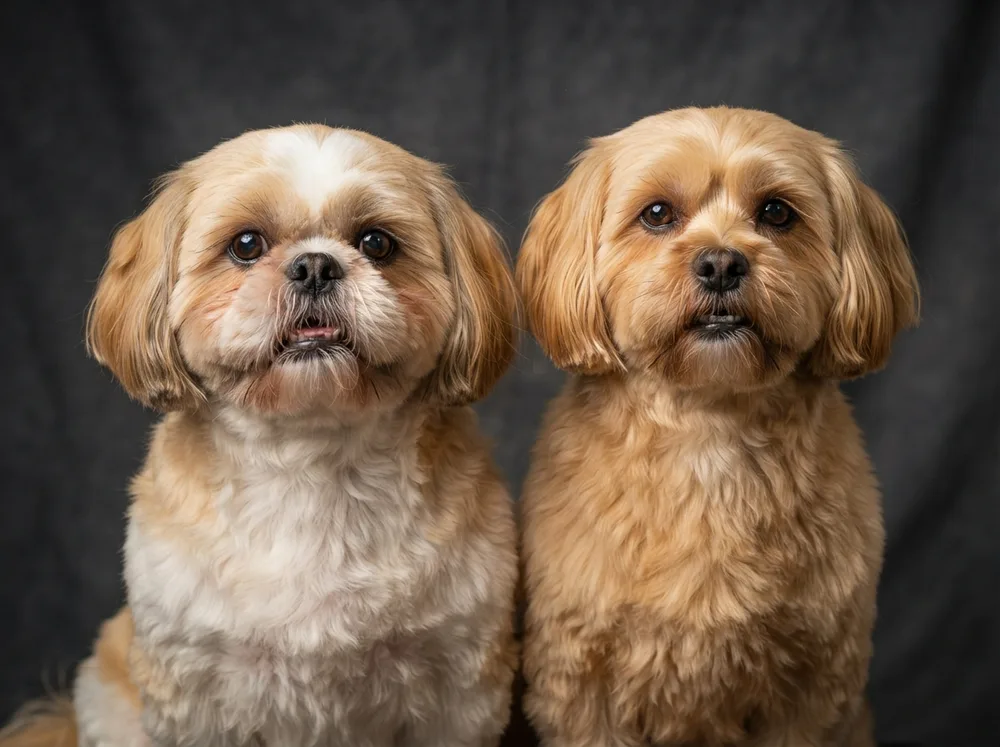
How do you tell a Lhasa Apso from a Shih Tzu?
Three fast tells. Muzzle: the Lhasa Apso has a longer muzzle; the Shih Tzu's face is flat. Coat: the Lhasa's is hard and straight, the Shih Tzu's soft and flowing. Temperament: the Lhasa is an aloof sentinel, the Shih Tzu a sociable lapdog. Both are on HDB's approved small-breed list.
Two lion dogs, compared honestly
Two lion dogs, one family tree
The Lhasa Apso and the Shih Tzu are look-alike breeds because they almost certainly share ancestors. The Lhasa Apso worked as a monastery watchdog in Tibet, the "bark lion sentinel dog" (abso seng kye) that alerted monks to strangers. The Shih Tzu was developed as a royal lapdog in the Chinese imperial court, most likely from Lhasa Apso and Pekingese ancestors, which is why the two breeds are so often mistaken for each other.
Both carry the "lion dog" (獅子狗) name, and both kept the long double coat of their Tibetan lineage. But the jobs were different: one guarded, one charmed. That split still shows in every temperament difference below, and the American Kennel Club's comparison draws the same line. If the flat face is what confuses you, the Pekingese vs Shih Tzu question is the related tangle.
The family tree, at a glance
- Lhasa Apso: Tibetan monastery sentinel
- Shih Tzu: Chinese imperial court lapdog
- Ancestry: most likely Lhasa x Pekingese
- Both called "lion dog" (獅子狗)
- Both on the HDB approved list
The side-by-side table
Side by side, the differences are consistent, just subtle. The Lhasa Apso is slightly larger, longer in the muzzle, and narrower in the skull; the Shih Tzu is smaller, flat-faced, and rounder in the head. We use Singapore units, not the inches and pounds every overseas comparison leaves you converting.
| Trait | Lhasa Apso | Shih Tzu |
|---|---|---|
| Height at the shoulder | About 25 to 28 cm | About 20 to 28 cm |
| Weight | About 5.4 to 8.2 kg | About 4 to 7.5 kg |
| Muzzle and head | Longer muzzle, narrower skull | Flat face, rounded head |
| Coat texture | Hard, straight, heavy double coat | Soft, flowing, luxurious coat |
| Temperament | Independent, wary of strangers | Sociable, affectionate people pleaser |
| Original job | Monastery watchdog | Palace companion |
| Lifespan | Roughly 12 to 15 years | Roughly 10 to 16 years |
The 60-second viewing checklist
A viewing checklist matters because look-alike puppies do get sold under the wrong breed name, especially on classifieds. Run these five checks at any viewing and you will know which breed a seller is actually showing you. It takes a minute.
Our own version of this is the breed-fit matching we do before any sale: every puppy we place carries a vet health check, vaccination records, a microchip, and breed identification, so "which is which" is never a guess.
Five checks at the viewing
- Muzzle first: visible length = Lhasa, flat = Shih Tzu
- Coat feel: hard and straight vs soft and silky
- Head shape: narrower skull vs rounded dome
- Ears: many Lhasas carry black tips on muzzle and ears
- Ask for the vet records and breed identification
Temperament: the sentinel and the socialite
The temperament difference is the biggest one, and the one photos cannot show. A Lhasa Apso is independent, a little aloof, and reserved with strangers; centuries of watchdog instinct mean it takes its time before it trusts a guest. A Shih Tzu is the opposite kind of small dog: outgoing, affectionate, a people pleaser that treats visitors as new staff.
That maps onto households cleanly. Homes with young children, elderly family members, or a steady stream of guests suit the Shih Tzu's sociable temperament. A quiet flat with one or two adults who want a loyal, slightly protective companion is where the Lhasa shines. Owner forums put it more bluntly: Lhasa threads describe a dog that is grumpy with strangers but devoted at home, while r/shihtzu owners describe a velcro dog, a shadow that follows you around.
Barking and your HDB neighbours
The Lhasa's alert bark is a feature in a Tibetan monastery and a liability in a corridor flat: it announces every footstep, and noise complaints are the fastest way to sour HDB living with a dog. The Shih Tzu is generally the quieter of the two. Either way, train the alert bark early; the free AVS-certified training lesson we include exists for exactly this.
Are both HDB approved?
Both breeds appear on HDB's approved small-breed list of roughly 62 breeds, so either can be legally kept in a flat. The Shih Tzu sits at item 48; the Lhasa Apso is also listed, which you can verify on HDB's keeping-pets guidelines. The rules are identical for both: one approved dog per flat, a mandatory AVS dog licence, and a fine of up to $4,000 for keeping a non-approved dog.
So HDB legality is not the tiebreaker here; both pass. Every puppy we place goes home with the licensing completed at purchase, so the paperwork is never your problem.
~62
Breeds on the HDB list
Item 48
Shih Tzu on the list
1 dog
Per HDB flat
$4,000
Fine, non-approved dog
Grooming: two expensive coats, one honest number
Grooming is the trap question in this comparison, because the honest answer is that both coats cost the same. Hair, not fur, means low shedding but a high maintenance coat on either breed: the Shih Tzu's soft coat needs daily brushing, and the Lhasa's hard straight coat needs brushing several times a week at minimum, or mats form behind the ears within days. PDSA's Shih Tzu care guidance backs the daily-brush figure.
In Singapore that means a professional groom every 4 to 6 weeks at $75 to $120 a session, roughly $900 to $1,400 a year, whichever breed you choose. Most owners here keep either coat in a puppy cut for the tropics. We ask every buyer the grooming-readiness question before we ever talk price, and the first professional groom is included with every puppy we place.
The coat bill, either breed
- Shih Tzu: daily brushing, no shortcuts
- Lhasa: several brushes a week, minimum
- Professional groom every 4 to 6 weeks
- $75 to $120 a session in Singapore
- About $900 to $1,400 a year
- Puppy cut: the practical tropical choice
Singapore heat: where the muzzle matters
Heat tolerance is where that muzzle difference stops being cosmetic. The Shih Tzu is a brachycephalic, flat-faced breed, so it sheds heat poorly and carries real heat sensitivity in Singapore's humidity. The Lhasa Apso's longer muzzle gives it somewhat better airflow, so it copes a little better outdoors, though its heavy double coat means it is no tropical athlete either.
Neither breed is unmanageable here; this is a management question, not a disqualifier. Walk early morning or after sundown, never midday. Keep shade, water, and aircon in the routine, and keep the coat in a practical cut. Climate awareness is a formal step in our Lifestyle-First Matching before we recommend a Shih Tzu to anyone.
Heat-stress signs, either breed: act immediately
- Heavy, laboured, noisy breathing that does not settle
- Bright-red gums or tongue
- Wobbling, collapse, or glazed unresponsiveness
- Cool the dog with water and moving air, and get to a vet NOW
Health beyond the heat
Each breed carries its own watch list beyond the climate. The Lhasa Apso is associated with renal dysplasia, a kidney condition, plus dry eye (keratoconjunctivitis sicca) and patella luxation. The Shih Tzu's list centres on its face: prominent eyes prone to injury and corneal ulcers, dental crowding in the short jaw, and ear infections under the drop ears. Both are generally long-lived small dogs; a vet health check before homecoming is the non-negotiable either way.
| Breed | Watch for | Typical lifespan |
|---|---|---|
| Lhasa Apso | Renal dysplasia, dry eye, patella luxation | About 12 to 15 years |
| Shih Tzu | Eye injuries and ulcers, dental crowding, ear infections, BOAS-spectrum breathing | About 10 to 16 years |
Training and daily life in a flat
Daily life with either breed is honestly similar: short walks, indoor play, modest exercise needs, and a stubborn streak at training time. The Lhasa's independence means it needs consistency and calm leadership, or it will politely run the household. The Shih Tzu is more eager to please but slower to potty-train than the internet promises; patience is part of the price, which is why the free first training lesson comes standard with every puppy we place.
Neither breed needs a garden. Both were bred to live at close quarters with people, which is exactly what makes them flat-friendly breeds in the first place.
Both are stubborn. The Lhasa tests your leadership; the Shih Tzu tests your patience.
Availability in Singapore: the practical difference
Availability is the difference no overseas comparison mentions. The Lhasa Apso is rarely stocked by licensed shops in Singapore; if your heart is set on one, expect a wait, an import, or an adoption search. The Shih Tzu is widely placed here; we alone have placed 30+ Shih Tzu as Shih Tzu specialists in Singapore, across gold and white, black and white, brindle, liver, red and white, and solid black.
That scarcity creates a real risk: mislabelled puppies. A look-alike puppy on Carousell listed as one breed can easily be the other, or a cross sold as either. Buy only from a shop you can find on the AVS public registry of licensed pet shops; checking that registry is a habit we recommend even when the shop is not us.
The Singapore market reality
- Lhasa Apso: rarely stocked by licensed shops
- Shih Tzu: widely available, 30+ placed by us
- Mislabelling risk is real on classifieds
- Verify any seller on the AVS registry
- Smuggled-dog buyer fined $7,000 by NParks
Price context, honestly
Our Shih Tzu are $3,888 to $4,888 all-in, published, no viewing-room surprises. All-in means the AVS licence handled at purchase, microchip, vaccinations, vet health check, the 30-item starter kit, home delivery with playpen setup, a free AVS-certified training lesson, and the first professional groom included.
Treat cheap look-alike listings as the red flag they are. A "bargain" from an unlicensed seller is often a smuggled puppy: buyers have been fined $7,000 by NParks, and a single parvovirus treatment can cost $5,000 to $10,000 with no guarantee of survival.
$3,888+
Our all-in starting price
30 items
In the starter kit
1st groom
Included with every puppy
45
Five-star Google reviews
If/then: which breed fits your household
Here is the verdict most comparisons dodge. Match the row to your household and take the answer seriously, including when the answer is neither. We would rather talk you out of the wrong breed than sell you the wrong dog, and the rest of the field is covered when you compare the Shih Tzu against every HDB-approved rival.
| If your household is... | Then lean... |
|---|---|
| A quiet flat that wants a watchdog presence | Lhasa Apso: the sentinel instinct is the point |
| Young children, elderly family, frequent guests | Shih Tzu: the sociable lapdog of the pair |
| A first-time owner | Shih Tzu: more forgiving, more eager to please |
| Anxious about heat and the flat face | Lhasa leaning: the longer muzzle copes better |
| Unwilling to budget $900 to $1,400 a year on grooming | Neither: both coats demand it |
Keep exploring: other Shih Tzu comparisons
Frequently asked questions
Are the Lhasa Apso and Shih Tzu related?
Almost certainly. The Shih Tzu was most likely developed in the Chinese imperial court from Lhasa Apso and Pekingese ancestors, which is why the two breeds look so alike.
How do I tell a Lhasa Apso from a Shih Tzu at a glance?
Check the muzzle first: a Lhasa Apso has a visibly longer muzzle and narrower skull, while a Shih Tzu has a flat face and rounded head. Then feel the coat: hard and straight on a Lhasa, soft and flowing on a Shih Tzu.
Are both breeds HDB approved in Singapore?
Yes. Both the Lhasa Apso and the Shih Tzu appear on HDB’s approved small-breed list of roughly 62 breeds. The same rules apply to both: one approved dog per flat, a mandatory AVS licence, and a fine of up to $4,000 for a non-approved dog.
Which is better for first-time owners?
The Shih Tzu, in most cases. It is more sociable, more eager to please, and more forgiving of training mistakes. The Lhasa Apso’s independence rewards experienced owners who enjoy consistent, calm leadership.
Which copes better with Singapore’s heat?
The Lhasa Apso, somewhat. Its longer muzzle sheds heat better than the Shih Tzu’s flat face. Both still need managed walks outside the midday heat, shade, water, and a practical coat cut in Singapore’s climate.
Which barks more, the Lhasa Apso or the Shih Tzu?
The Lhasa Apso. It was bred as a monastery watchdog and keeps a strong alert bark, which matters in a corridor HDB flat. The Shih Tzu is generally the quieter, more easygoing of the two.
Can I buy a Lhasa Apso from a licensed shop in Singapore?
Rarely. Lhasa Apsos are seldom stocked by AVS-licensed shops here, so expect a wait or an adoption search. The Shih Tzu is widely available; we have placed 30+ ourselves. Always verify any seller on the AVS public registry.
How much does grooming cost for either breed in Singapore?
About the same for both: a professional groom every 4 to 6 weeks at $75 to $120 a session, roughly $900 to $1,400 a year, plus regular brushing at home. Budget it before choosing either breed.
Meet your Shih Tzu
Come say hello at Balestier
2 Balestier Road #01-701, Singapore 320002 · Weekdays 12pm–6pm · Weekends 10am–6pm. Or message us first: tell us about your home and routine, and we'll tell you honestly if a Shih Tzu fits.
Landed on the Shih Tzu side?
Read the grooming reality first: daily brushing and a $75 to $120 groom every 4 to 6 weeks. Ready for that? Message us.
Read the grooming reality