Grooming and coat
How to brush a Shih Tzu at home
The five-minute daily routine that keeps mats away: line brushing, the three tools that matter, the zones that betray you, and what Singapore humidity changes.
Nelson and Kim, Curious Tails · AVS licence AS24J00046
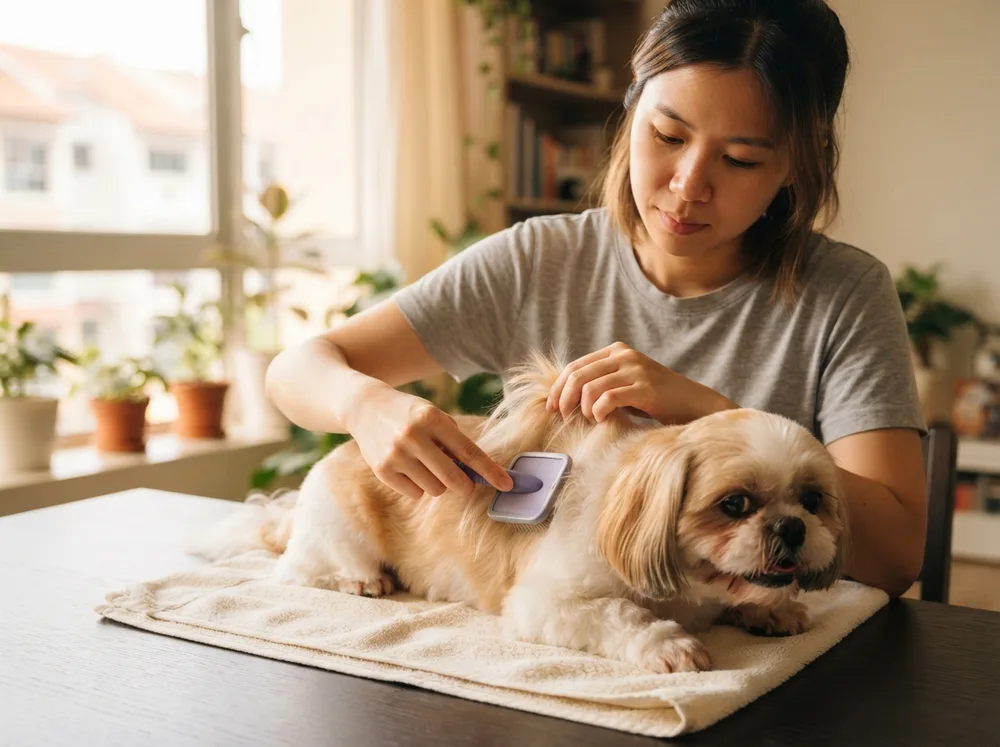
How often, and how, do you brush a Shih Tzu?
Daily, for about five minutes. Mist the coat, part it in lines and brush each layer from the skin outward with a pin or slicker brush, then run a metal comb through the ears, armpits and hind legs, the three places mats form first. In Singapore's humidity, daily is not a counsel of perfection; it is the minimum.
Five minutes a day, honestly
Why a Shih Tzu needs brushing every day
Brushing a Shih Tzu is a daily job because the breed grows hair, not fur. The coat grows continuously, like human hair, which is why the breed sheds so little and why every skipped day compounds into tangles and knots. Ask how often to brush a Shih Tzu and the honest answer is every day; daily brushing is the whole foundation of Shih Tzu coat care.
"Low-shedding" is how the breed gets sold. The honest phrase is high-maintenance coat: you are not buying less grooming, you are buying a five-minute daily habit plus a professional groom every four to six weeks for 12 or more years. That is the deal we spell out on our guide to Shih Tzu grooming in Singapore before anyone commits.
The daily requirement is not our invention. PDSA's breed care guidance puts it plainly: a Shih Tzu needs a daily brush to keep the coat knot-free.
The coat, in four facts
- Hair, not fur: grows continuously
- Low shedding, high labour
- Daily brush ≈ 5 minutes
- Salon groom every 4–6 weeks anyway
The three tools that actually matter
A pin brush, a slicker brush and a metal comb cover everything; the rest of the pet-shop wall is optional. The pin brush does the gentle daily pass, the slicker works out tangles, and the metal comb is the truth-teller: if it will not pass through to the skin, you have found a mat.
Add a detangling spray and mist the coat every time. Never brush a bone-dry coat: dry brushing snaps hair, builds static, and turns a calm five minutes into a fight. That is the whole grooming kit for mat prevention at home; everything else is nice-to-have.
The comb test
After brushing a section, run the metal comb from skin to tip. Glides through: done. Snags halfway: a hidden mat survived the brush, and the surface only looked finished.
How do you line brush a Shih Tzu? The 5-step routine
Line brushing is a sectioning technique that parts the coat in horizontal lines and brushes each layer from the skin outward, so the brush reaches the root instead of skimming the top. It sounds fussy; in practice it is five repeatable steps.
Brush the dog you cannot see: the layer at the skin, not the layer that photographs well.
| Step | What you do | Why |
|---|---|---|
| 1. Mist | Light spray of detangler over the section | Dry brushing breaks hair |
| 2. Part | Lift a horizontal line of coat with one hand | Exposes hair at skin level |
| 3. Brush | Pin brush from the skin outward, tips first on any snag | Roots are where mats start |
| 4. Comb | Metal comb through the same layer to the skin | Verifies the layer is truly clear |
| 5. Move up | Next line, working feet to spine, rear to head | Nothing gets skipped twice |
The zone map: where mats hide
Mats form where friction and trapped moisture meet: behind the ears, under the collar line, in the armpits, and on the hind legs and belly. These zones rub all day and dry slowest, so give them the comb every single day even when you shortcut the rest.
The stakes are more than cosmetic. USDA animal-care guidance on preventing matted hair notes that mats trap moisture against the skin and can lead to skin infections underneath, which is why a groomer will not simply "brush out" a coat that has gone too far.
Ears
Mat zone 1: behind + under flap
Armpits
Mat zone 2: harness friction
Hind legs
Mat zone 3: fastest in humidity
Collar line
Mat zone 4: daily rubbing
Singapore humidity changes the rules
Humidity is the variable overseas brushing guides never mention, and here it decides everything. In Singapore's climate mats form fastest around the ears and hind legs, and local groomers see cadences tighten from the usual four to six weeks to every two to three weeks in peak humidity, a pattern documented in this Singapore grooming cost guide.
Two local habits pay for themselves. Dry the coat fully after rain-season walks, because a damp coat mats in hours, not days. And brush after the evening walk, when the day's debris is in the coat and the aircon hours ahead will set any tangle you leave.
Wet coat, fast mats
Water tightens tangles into felt. Towel-dry thoroughly after wet walks and baths, and never bathe a dog that still has mats in the coat; brush first, always.
How do you brush a puppy that hates the brush?
Start smaller than you think: sessions under two minutes, the softest brush you own, and stop before the puppy struggles rather than after. Trainers teach exactly this progression, swapping to a softer brush the moment body language says "too much", then working back up.
A recurring thread among Shih Tzu owners on r/shihtzu and owner forums is that the adults who lie calmly for grooming were the puppies who got daily micro-sessions with a treat at the end, from week one. Not one owner reports regretting starting early.
We include a free AVS-certified training lesson with every puppy, and brush tolerance is one of the first things worth spending it on.
End every session one minute before the puppy wants you to, and always on a treat.
Does the puppy cut end the routine?
No, it halves it. A puppy cut, the short practical trim most Singapore Shih Tzus wear for the heat, roughly halves brushing time but does not delete the job: the friction zones still mat, just slower.
In a short coat, aim for a quick daily pass and one thorough weekly comb-through. In a long coat, the full five-step routine, daily, no exceptions. That trade-off is most of the reason the short cut wins here.
Found a mat anyway? Triage, honestly
Small mat, caught early: mist it, hold the hair at the base so you are pulling mat and not skin, and work from the tips inward with the comb. Patience beats force, and force teaches the dog to fear the brush.
A mat the comb will not enter, or one sitting tight against the skin, is a groomer's job, and sometimes the kind answer is the clippers. We wrote a separate guide on how to deal with a matted Shih Tzu for exactly that morning.
When to stop pulling
If the skin moves with the mat, or the dog flinches repeatedly, stop. Skin-tight matting can hide irritation or infection underneath; let a professional take it down safely.
Face, eyes and top-knot: the delicate five percent
Around the face, swap the slicker for the comb. Slicker pins near those large, prominent eyes are an injury waiting to happen; a fine comb through the beard, moustache and cheeks does the job safely.
The top-knot is function dressed as fashion: it keeps hair out of the eyes, which matters on a breed whose eyes sit exposed. On light coats, add a daily tear-stain wipe while you are there; thirty extra seconds, and the face stays clean.
What does skipping brushing actually cost?
Five minutes a day is the cheapest line in the whole ownership budget. Skip it and the bill arrives at the salon: dematting surcharges on top of the usual $75 to $120 session, or a full shave-down when the coat is past saving, plus a dog that now associates grooming with pain.
The professional groom every four to six weeks, about $900 to $1,400 a year, happens regardless; brushing is what decides whether those sessions are routine or rescue. This is the honesty gate we apply before we sell: are you ready for the daily brush and the groomer on retainer? If yes, come meet our healthy Shih Tzu puppies in Singapore, and the first professional groom is included with every one.
5 min
Daily brush
$75–120
Salon session
4–6 wks
Groom cadence
$900–1,400
Per year, budgeted
The 9-to-12-month coat change: brushing’s hardest season
Somewhere between 9 and 12 months, the soft puppy coat gives way to the adult coat, and the loose puppy hairs tangle into the incoming coat instead of falling free. For a few months, brushing needs roughly double: twice-daily passes through the worst of it is normal, not a sign something is wrong.
Many owners schedule the first proper puppy cut in this window and let the adult coat grow in short. Whatever you choose, do not slack off now; the coat change is when well-brushed puppies become matted teenagers.
A routine that sticks
The routine that survives is the one welded to something you already do. After the evening walk works best in Singapore: the day's debris comes out, the coat goes into the aircon hours clean, and the dog is pleasantly tired.
Same time, same quiet spot, treat at the end, and one thorough full-body comb-through on the weekend as an audit. That is the whole system. It is five minutes; the alternative is a shave-down and an apology.
Five minutes a day is not the price of a beautiful coat. It is the price of a comfortable dog.
Keep the coat winning
Frequently asked questions
How often should I brush my Shih Tzu?
Daily. The coat grows continuously like human hair, and in Singapore’s humidity mats can form within days. Five minutes a day beats a painful hour of dematting every time.
What is the best brush for a Shih Tzu?
Three tools, not one: a pin brush for the daily pass, a slicker brush for tangles, and a metal comb to verify you have reached the skin. Add a detangling mist and never brush a dry coat.
How do I brush a Shih Tzu puppy that hates it?
Sessions under two minutes, softest brush first, stop before the puppy struggles, treat at the end every time. Owners in Shih Tzu communities consistently report that daily micro-sessions from the first week home produce adults that tolerate grooming calmly.
What do I do if I find a mat?
Mist it, hold the hair at the base so you are not pulling skin, and work from the tips inward with a comb. If the comb will not pass or the mat sits against the skin, book the groomer. Never bathe a matted dog; water tightens mats.
Does a puppy cut mean I can stop brushing?
No. A short coat roughly halves the time, but mats still form behind the ears, in the armpits and on the hind legs. Do a quick daily pass and a thorough weekly comb-through even in a puppy cut.
When should I start brushing my puppy?
The day it comes home. Short, positive sessions build tolerance before the adult coat arrives at 9 to 12 months, when the coat change roughly doubles the brushing workload for a few months.
What happens if I skip brushing?
Mats form at the friction zones, trap moisture against the skin and can cause skin infections underneath. Groomers charge dematting surcharges on top of the usual $75 to $120 session, and a badly matted coat often has to be shaved down entirely.
Meet your Shih Tzu
Come say hello at Balestier
2 Balestier Road #01-701, Singapore 320002 · Weekdays 12pm–6pm · Weekends 10am–6pm. Or message us first: tell us about your home and routine, and we'll tell you honestly if a Shih Tzu fits.
Still deciding?
Read the price guide first: every dollar explained, no surprises at the shop.
See the price guide