Health & daily care
Shih Tzu dental care and crowding
Shih Tzu dental care starts with an anatomy problem: 42 adult teeth packed into a jaw shortened by the flat face. Here is what crowding does, the five minutes a day that hold it back, and what a real veterinary dental costs in Singapore.
Nelson and Kim, Curious Tails · AVS licence AS24J00046
Why do Shih Tzus have such bad teeth?
A Shih Tzu carries 42 adult teeth, the same count as a Labrador, inside a jaw shortened by the flat face. Teeth rotate, overlap and trap food, so plaque settles earlier and gum disease starts younger. Daily brushing and a vet who checks the mouth are what keep the odds on your side.
Vet-sourced, plainly told
The short jaw is the whole problem
Shih Tzu dental problems trace back to one measurement. A Shih Tzu grows a full set of teeth, 42 of them as an adult, the same count as a Labrador. The Labrador got a long muzzle to fit them in. The Shih Tzu got a shortened skull, so the teeth do what crowded things do. They rotate, they overlap, they lean on each other.
The plain name for the result is Shih Tzu dental crowding. Crowded, rotated and overlapping teeth open gaps a straight arch would never hold, so food debris trapped between teeth sits there instead of washing away. Saliva does a lot of quiet cleaning, and it cannot flush surfaces pressed flat together. Plaque settles earlier and grips harder than on a longer-muzzled dog the same age.
This is not a fringe observation from breed forums. The vet charity PDSA lists it on the breed's own health page, alongside the eye and airway conditions this brachycephalic breed is better known for. Shih Tzu teeth problems start with geometry, not with neglect.
Same 42 teeth as a retriever. A fraction of the jaw to put them in.
What vets call dental crowding in the short jaw
PDSA names "rostral bite problems" among the conditions the breed is prone to, and defines it as crowding and displaced teeth caused by a lack of space in the mouth. A mild malocclusion or a slight underbite turns up for the same reason.
How common is dental disease in a small dog?
Common, and worse the smaller the dog. Cornell's veterinary college puts some component of periodontal disease in dogs in 80 to 90 percent of dogs over three. It adds that gum disease in small dogs runs worse than in large breeds, and that prevalence increases with age.
The largest dental study of dogs to date puts a number on the size effect. WALTHAM researchers reviewed records from more than three million pets and found extra-small breeds five times more likely, at the upper end, to be diagnosed with periodontal disease than giant breeds over 25 kg. Their extra-small band was dogs under 6.5kg, and a grown Shih Tzu weighs 4 to 7.25 kg. Most sit inside it.
Age compounds all of it, and dental disease drags lifespan down quietly rather than dramatically. That is why teeth sit beside weight, eyes and heat in the wider Shih Tzu health profile we set out in our guide to Shih Tzu health and lifespan. The levers that push a dog toward the top of a 10 to 16 year range are unglamorous and daily.
The prevalence numbers
- 80 to 90 percent of dogs over three are affected (Cornell)
- Up to 5x the risk for dogs under 6.5kg (WALTHAM)
- Drawn from more than 3 million pet records
- Prevalence increases with age, every single year
- A grown Shih Tzu weighs about 4 to 7.25 kg
What does gum disease actually do to a Shih Tzu?
It works from the gum line down. Plaque causes inflamed gums, which is gingivitis. Periodontal pockets open between tooth and gum. Bacteria under the gum line then wreck soft tissue and cause bone loss around the teeth, which is periodontitis. The end point is pain, gum recession and tooth loss.
Cornell is blunt about what owners get wrong. The villain is plaque, an invisible bacterial film, not the visible tartar buildup people photograph and worry about, and early trouble often shows no outward signs at all. Bacteria recolonise a professionally cleaned tooth within days, which is why daily tooth brushing has to be a habit rather than an event.
There is a whole-body angle too. Cornell links periodontal disease to liver and heart disease, with bacteria entering the bloodstream from an infected mouth as the proposed route. It is also, honestly, a pain problem. Dogs do not complain, they adapt, and the signs of dental pain are quiet by design: a Shih Tzu chewing on one side has usually been sore for weeks.
Bad breath in dogs: the warning sign most owners normalise
- Halitosis that clears a room, not ordinary dog breath
- Red, puffy or inflamed gums where gum meets tooth
- Dropping food, or chewing on one side only
- Pawing at the mouth, or reluctance to eat kibble
- Any tooth that looks grey or brown, or shifts when touched
When do Shih Tzu puppies lose their baby teeth?
Puppies carry 28 deciduous teeth and trade them for a full set of 42 adult ones. VCA Animal Hospitals puts the start of the swap at roughly 3.5 to 4 months, so the mess peaks with teething at four to six months, and most puppies have their adult teeth by seven months. Your puppy goes home at week nine, still on the baby set.
The watch item is retained deciduous teeth, also called persistent deciduous teeth: puppy teeth that don't fall out when the adult ones arrive. VCA notes that smaller breeds and short-nosed breeds are the ones prone to it, usually at the canines, and that leaving one in place makes it unlikely the adult tooth will settle into position without orthodontic help. Baby teeth alongside adult teeth show as a double row of teeth at the front. Lift the lip at five months and count.
Timing is the practical answer. Removal needs an anaesthetic, so removing retained teeth at sterilisation is the usual plan, and for a Shih Tzu that comes from around seven months. Raise it at the six-month check, not on the morning of surgery.
| Age | What is happening | What you do |
|---|---|---|
| About week 9 (go-home) | 28 baby teeth, all present and needle sharp | Handle the muzzle daily, no brush needed yet |
| 3 to 4 months | Incisors begin swapping for adult teeth | Let the puppy lick dog toothpaste off a finger |
| 4 to 6 months | Peak teething, chewing everything in reach | Short, frequent brushing plus safe chews |
| 5 to 6 months | Canines swap: the retained-tooth window | Check for a double row, flag it to the vet |
| 6 to 7 months | All 42 adult teeth in place | Full daily routine; retained teeth out at sterilisation |
The five-minute routine that actually works
Brushing your Shih Tzu's teeth every day is the standard, and it is not an aspiration. Colorado State's veterinary teaching hospital recommends daily tooth brushing, with the goal of covering the outside surfaces of all the teeth each time. Brush the outside surfaces properly and treat the inner faces as a bonus.
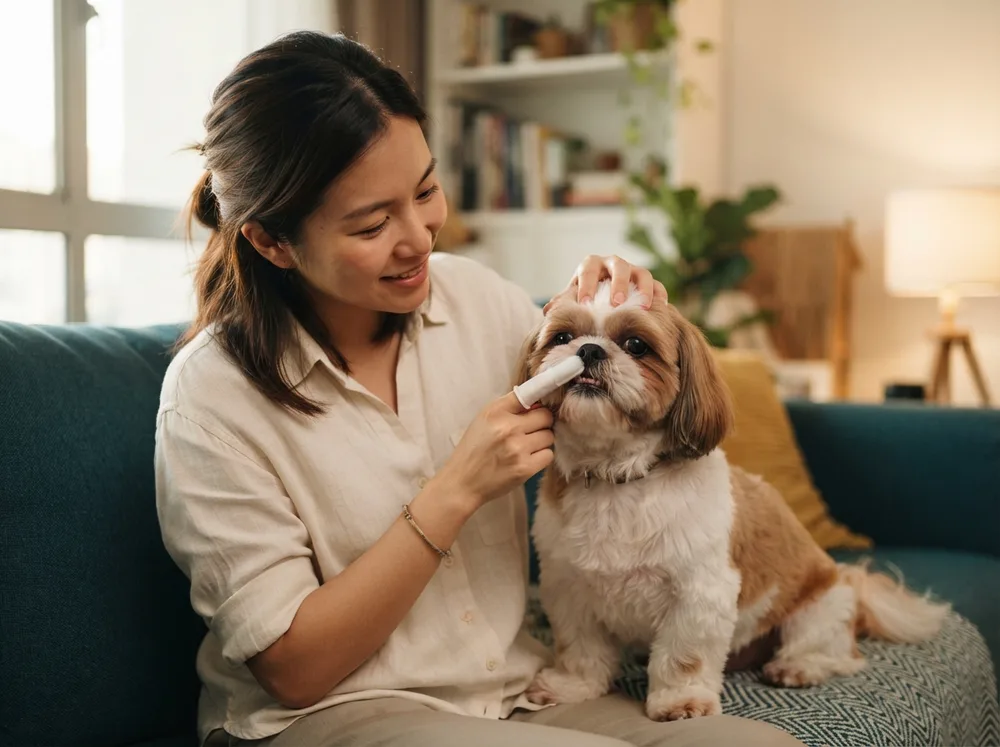
Use enzymatic toothpaste made for dogs, plus a small soft-headed toothbrush (a child's brush is the right size) or a silicone finger brush. The bristle action does the work; the paste mostly buys cooperation. Lift the lip, angle the bristles into the gum line, and use a small circular brushing motion from the back molars forward. Tie the top-knot out of the eyes first, because those prominent eyes sit at brush height.
Never reach for your own tube. Dogs swallow instead of spitting, and human paste assumes the opposite. Fluoride is toxic to dogs at the doses that build up over months of swallowed toothpaste, and anything sweetened with xylitol is dangerous in one sitting. A Shih Tzu dental care routine built at twelve weeks is a fraction of the fight it becomes at two years. Three to four times a week minimum still beats good intentions.
Your Shih Tzu dental kit
- Enzymatic toothpaste for dogs, never human toothpaste
- A small soft-headed toothbrush or a finger brush
- Brush the outside surfaces, small circular motion
- A daily brushing habit is the target, not a stretch goal
- Three to four times a week minimum, five minutes each
What if your Shih Tzu fights the toothbrush?
You back up and go slower. Getting a Shih Tzu used to brushing is a one to two week project, not a single session: handle the mouth first with nothing in your hand, then paste on a finger, then a few teeth, then the rest. Reward every attempt, including the ones that go badly.
Two details change the odds. Do not prise the jaw open, because that is the part most dogs object to. Lift the lip and brush with the mouth closed instead. And pick a fixed slot in the day, since this breed handles a boring routine far better than a surprise.
Owner forums on toothbrushing battles are full of this exact scene, and the stubborn streak is part of what you bought. Shih Tzu owners commonly report that a dog who fought the brush at four months tolerates it by eight, purely through repetition. Dental wipes and chews are a fair bridge. They are not the destination.
The two-week ladder
- Days 1 to 3: touch the muzzle, lift the lip, treat, stop
- Days 4 to 6: let them lick dog toothpaste off your finger
- Days 7 to 9: rub paste onto the front teeth with a finger
- Days 10 to 12: brush four or five teeth, then finish early
- Days 13 to 14: the full outside arch, both sides
Do dental chews and dry food actually work?
Chews help, within limits. VOHC accepted products clear two sets of clinical trials showing an average reduction of at least 20 percent in plaque or tartar before the Veterinary Oral Health Council puts its seal on the pack. That is a real, measured effect, and it is well short of a brush, because chewing never reaches below the gum line.
Below the gum line is where periodontal disease actually lives. That one fact is why every veterinary source lands in the same place: chews help but do not replace brushing. They earn their keep for dogs who genuinely will not tolerate a brush. Water additives and dental wipes sit in the same category, useful and partial.
A chew is also food. On a 5 kg dog a daily one can be a tenth of the day's calories, so take it out of dinner. And the kibble versus soft food argument is a weak lever: ordinary dry food shatters rather than scrubs, so unless your vet has prescribed a dental diet, treat food as nutrition and not as a dental plan.
Chews buy you time. Brushing buys you teeth.
What a chew cannot do
- Reach plaque below the gum line, where disease starts
- Remove tartar already bonded to the tooth surface
- Replace a veterinary dental once disease is established
What does a dog dental cost in Singapore?
Budget $600 to $1,500 in Singapore for a full veterinary dental. A proper one is billed as a COHAT, short for comprehensive oral health assessment and treatment, and it is an anaesthetic dental from start to finish. Dental scaling and polishing is a single line of it, sitting alongside pre-anaesthetic bloodwork, dental radiographs, monitoring and, very often, extractions.
Search dog teeth scaling cost Singapore and the first figure you meet is usually a "$100 to $200 basic clean". That is not a dental. A Singapore scaling cost guide puts published clinic pricing for a dog under 10 kg from about $450 with anaesthesia, IV fluids and monitoring included, before bloodwork ($80 to $200), dental x-rays ($75 to $250) or the consultation fee ($40 to $120).
Tooth extraction is what moves the total. Extractions per tooth cost from roughly $20 to over $100 for a simple one, and a surgical extraction can reach $400 for a single tooth. A crowded Shih Tzu mouth left alone for years rarely needs just one.
One service to decline outright. Anaesthesia-free scaling is not a dental: scraping visible tartar off a conscious dog tidies the part you can see and leaves everything under the gum line untouched.
| Line item | Typical Singapore range | What it covers |
|---|---|---|
| Scaling and polishing, dog under 10 kg | From about $450 | Commonly includes anaesthesia, IV fluids, monitoring |
| Pre-anaesthetic bloodwork | $80 to $200 | Checks organ function before anaesthesia |
| Dental x-rays (radiographs) | $75 to $250 | Finds root disease invisible above the gum |
| Consultation fee | $40 to $120 | The assessment that sets the treatment plan |
| Simple extraction | $20 to $100+ per tooth | Loose or single-rooted teeth |
| Surgical extraction | Up to $400 per tooth | Sectioned roots, gum flap, sutures |
| Realistic all-in | $600 to $1,500+ | Varies with age, condition and extraction count |
Is anaesthesia safe for a flat-faced dog?
Anaesthesia for flat-faced breeds carries extra airway considerations, which is precisely why a real dental plans around them. A brachycephalic dog has a narrowed airway, so intubation, oxygen, IV fluids and continuous monitoring are not upsells on a Shih Tzu dental. They are the safety margin you are paying for.
Say the words "flat faced" to your vet well before the day. Ask what bloodwork is included, who watches the monitors while the vet works, and how recovery is supervised, because brachycephalic anaesthesia risk peaks on waking rather than going under.
The same anatomy that complicates an anaesthetic also caps heat tolerance, the other daily flat-face reality here, and our guide to keeping a Shih Tzu cool in Singapore heat covers that side of it. Neither is a reason to avoid the breed. Both are reasons to plan.
Weigh the two risks honestly. A monitored anaesthetic in a well-run clinic is small and managed. An infected, painful mouth left alone for years is not.
Four things to ask before booking a dental
- Is pre-anaesthetic bloodwork included, or quoted separately?
- Are dental x-rays taken as standard on a small breed?
- Who monitors anaesthesia while you are operating?
- How is a flat-faced dog supervised through recovery?
Use the 4 to 6 week groom as your dental checkpoint
Dental care for Shih Tzus in Singapore comes with one built-in advantage: the dog already has a grooming appointment every 4 to 6 weeks. That runs about $75 to $120 a session, roughly $900 to $1,400 a year, and it is the most reliable recurring booking in the calendar. A groomer spots dental trouble early, because they see the mouth up close and in better light than you have at home. Ask what it looked and smelled like.
Between grooms, run the lift the lip check once a month. Peel the upper lip back on both sides for a quick gum colour check: pink and tight is what you want, red or receding is not. Thirty seconds on the same date each month is a monthly mouth check that catches the slide long before your dog gives anything away.
Every puppy placed by our Singapore Shih Tzu specialists, an AVS licensed pet shop, is vet health checked before going home and comes with the first professional groom included. Bring the question to that first appointment: how do the teeth look?
The monthly lift-the-lip check
- Peel the upper lip back on both sides
- Gum margins should look pink and tight, not red
- No brown crust building where tooth meets gum
- No wobble on the canines or the small front teeth
- Sour breath is common, rotten breath is a vet visit
What if your Shih Tzu is already losing teeth?
Book the vet rather than wait it out. Loose teeth in an older Shih Tzu usually mean the bone anchoring them has already gone, so wobbly teeth are a live source of pain and infection, not something that settles on its own. A tooth root abscess can sit quietly under a normal-looking gum for months. Extraction, once it is done, is normally a relief.
Owners hesitate because they picture a toothless dog struggling to eat. In practice dogs cope remarkably well with missing teeth, dry food included, and plenty become brighter and hungrier once the sore ones are gone. Losing teeth early is a reason to act, not a reason to give up on the mouth.
From about age nine or ten, switch to senior dental checks twice a year with the mouth explicitly on the list. Senior Shih Tzu teeth hide their problems well, so the schedule has to do the noticing for you.
Book the vet, do not wait and see
- A tooth that shifts when you touch it
- Grey, brown or visibly fractured tooth surfaces
- Swelling under an eye or along the jaw line
- Sudden reluctance to eat, or food dropped mid-meal
- Breath that changes sharply within a week or two
The honest math: five minutes a day against a $1,500 bill
A tube of dog toothpaste and a brush cost less than a single groom. Prevention costs less than treatment is a tired line, but here the gap runs to roughly a hundredfold, and brushing is the only home habit that reaches the disease before anaesthesia becomes the answer.
We say this with the same face we use for the grooming talk, and it sits inside the grooming-readiness question we ask every buyer. A Shih Tzu is a low-shedding, high-maintenance dog: daily brushing for the coat, daily brushing for the teeth, and a groomer on retainer for twelve years or more. Budget for dental care before the puppy, not after the first $1,200 dental, and fold it into the honest lifetime cost alongside food and vaccinations.
None of this promises your Shih Tzu will never need a dental. Crowding is structural, some dogs need scaling despite genuinely good home care, and no shop or vet can rule that out. What daily brushing changes is the odds, the age at which trouble starts, and how many teeth are still in the mouth at twelve.
Budget the care before the puppy, not after the first $1,200 dental.
42
Adult teeth, one short jaw
80-90%
Of dogs over 3 affected
5 min
The daily routine
$600-1,500
A Singapore dental
Keep exploring
Frequently asked questions
Why do Shih Tzus have bad teeth?
A Shih Tzu carries the same 42 adult teeth as a large dog inside a shortened brachycephalic jaw. Teeth rotate, overlap and trap food, so plaque and tartar build faster and gum disease starts earlier than in longer-muzzled breeds.
How often should I brush my Shih Tzu’s teeth?
Daily is the goal, and three to four times a week is the honest minimum. Use dog toothpaste and a small soft brush, and cover the outside surfaces. Never use human toothpaste: dogs swallow it, and fluoride and xylitol are not safe for them.
How much does dog teeth cleaning cost in Singapore?
A full veterinary dental realistically costs $600 to $1,500 or more in Singapore, because it includes general anaesthesia, bloodwork, x-rays and monitoring. Extractions add roughly $20 to $100 per simple tooth, and up to $400 for a surgical one.
What are retained puppy teeth?
Baby teeth that fail to fall out as the adult ones erupt, leaving a double row, most often at the canines. VCA notes small and short-nosed breeds are prone to it. Vets often remove stubborn ones under the same anaesthetic as sterilisation.
Are dental chews enough for a Shih Tzu?
No. Chews accepted by the Veterinary Oral Health Council must show at least a 20 percent cut in plaque or tartar, which is real but partial. They cannot reach below the gum line where periodontal disease starts, so brushing still does the heavy lifting.
Is anaesthesia safe for a flat-faced dog?
It carries extra airway considerations, which is exactly why a proper dental includes pre-anaesthetic bloodwork, intubation and monitoring. Raise the flat face with your vet before the day. Managed carefully, it is a routine procedure in a well-run clinic.
What are the signs my Shih Tzu has dental pain?
Bad breath is the earliest flag. Watch for dropping food, chewing on one side, pawing at the mouth, red or bleeding gums, and reluctance to eat kibble. Any loose or discoloured tooth needs a vet visit rather than a wait.
Meet your Shih Tzu
Come say hello at Balestier
2 Balestier Road #01-701, Singapore 320002 · Weekdays 12pm–6pm · Weekends 10am–6pm. Or message us first: tell us about your home and routine, and we'll tell you honestly if a Shih Tzu fits.
Still weighing it up?
The full lifetime cost of a Shih Tzu in Singapore, groomer and vet dentals included.
See the cost ledger