Health & daily care
Shih Tzu eye care: protecting those big eyes
Shih Tzu eye care takes two minutes a day: a wipe, a hair check, a glance. Here is the honest routine, the conditions worth knowing by name, and the signs that mean a vet today.
Nelson and Kim, Curious Tails · AVS licence AS24J00046
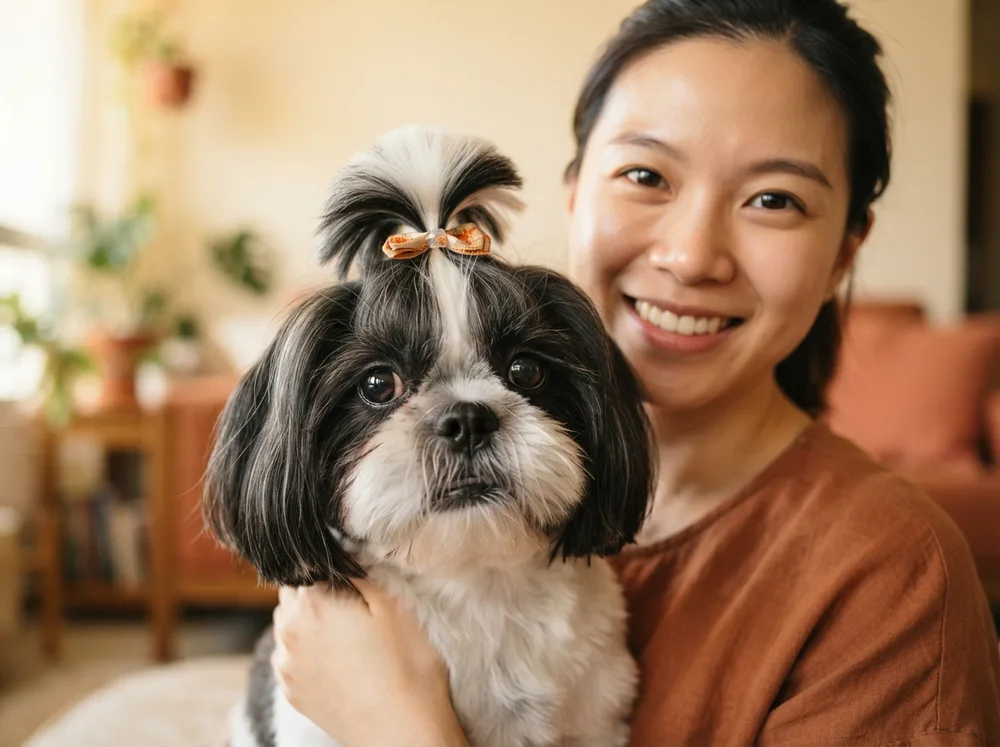
What does Shih Tzu eye care involve?
About two minutes a day. Wipe discharge with a clean damp cotton pad from the inner corner outward, one pad per eye; keep facial hair tied in a top-knot or trimmed clear of the cornea; and glance at both eyes for redness, squinting or cloudiness. Those big, shallow-set eyes are the breed's most exposed feature, and the routine is what protects them.
Vet-cited, honestly framed
Why Shih Tzu eyes need more care than most breeds
Shih Tzu eyes sit in shallow sockets on a flat face, so more of the cornea is exposed to air, dust and stray hair than on a longer-muzzled dog. That anatomy is why PDSA's breed health page lists dry eye, cataracts, progressive retinal atrophy and retinal detachment among the conditions the breed is prone to.
None of this is a reason to avoid the breed. It is a reason to build a small daily habit, the same way we cover the whole flat-face picture in our Shih Tzu health guide. Before we place a puppy, "do you understand the flat face?" is one of the two questions we ask every buyer, and the eyes are half of that question.
The exposure problem
- Shallow sockets leave more cornea uncovered
- Facial hair grows straight into the eye line
- Prominent eyes are easier to injure on trauma
- PDSA lists KCS, cataracts and retinal disease for the breed
The two-minute daily routine
The routine is short and boring, which is exactly why it works. Once it lives next to your own morning coffee, you will not skip it.
Morning: soak a cotton pad in warm water (plain, or dog-safe saline), and wipe gently from the inner corner outward. Use a fresh pad for the second eye so you never carry an infection across. Evening or after walks: a five-second glance at both eyes for redness, squinting or new discharge. A small amount of clear or slightly crusty morning gunk is normal; anything yellow-green, and you are booking a vet visit, not buying wipes.
Skip the human eye drops
Never put your own eye drops in a dog's eye without a vet's say-so. Some are harmless lubricants; anti-redness drops are not. If an eye looks like it needs medicine, it needs a vet first.
Tear stains: what works and what is theatre
Tear stains are pigment, not dirt. Compounds in tears called porphyrins dye light fur reddish-brown, which is why our gold and white and red and white puppies show staining more visibly than a solid black coat, as WebMD's veterinary guide to tear stains explains.
The honest fix is the routine above: a daily warm-water wipe and facial hair kept short around the eyes. Most stain-remover products are theatre in a bottle. The one time stains matter medically is when they suddenly get worse, because heavier tearing can signal an irritated eye, blocked tear ducts or the start of a real problem.
Tear stains are a laundry problem. A sudden increase in tearing is a vet problem. Learn to tell the two apart.
The top-knot is eye protection, not a hairstyle
The Shih Tzu top-knot existed long before Instagram. Its job is to hold the head fall, the hair that would otherwise hang over the eyes, off the cornea, because stray hairs against an eyeball cause irritation and, eventually, ulcers. Tie it loose with a small latex-free band, never so tight it pulls the skin, and redo it daily rather than leaving one band in for days.
Not a top-knot household? Ask your groomer for a short, rounded face trim instead. In Singapore's humidity most owners land on the puppy cut anyway, and the every 4 to 6 weeks salon cadence (about $75 to $120 a session) covered in our guide to Shih Tzu grooming in Singapore keeps the eye area maintained between your daily wipes.
Hair-management options
- Top-knot: loose, latex-free band, redone daily
- Face trim: groomer rounds the muzzle and brow
- Puppy cut: the practical Singapore default
- Either way: no hair touching the cornea, ever
Dry eye (KCS): the big one
Keratoconjunctivitis sicca, dry eye, is the condition every Shih Tzu owner should know by name. PDSA describes it as one or both eyes not producing a normal amount, or type, of tears, which leaves the cornea unprotected and open to infections and ulcers.
Diagnosis is quick and painless: the Schirmer tear test, a paper strip that measures tear production in one minute, as VCA Animal Hospitals explains. Treatment is usually daily tear-stimulant drops, cyclosporine or tacrolimus, and here is the honest part: KCS is rarely curable, but it is very manageable, and most dogs on consistent daily drops stay comfortable for years. Budget for it as a for-life line item, not a one-off vet bill.
Watch for the early signs
- Red, irritated-looking eyes that keep recurring
- Thick, sticky discharge instead of watery tears
- Frequent blinking or rubbing the face on furniture
- A dull, dry look to a normally glossy eye
Corneal ulcers and the 24-hour rule
A corneal ulcer is a wound on the surface of the eye, and on a flat-faced breed it is the emergency to respect. Squinting, holding one eye shut, pawing at the face or a suddenly weepy eye means a vet within 24 hours, full stop. Ulcers can deepen from minor to sight-threatening within days, and "let's see if it clears up" is how Shih Tzus lose eyes.
The same prominence that makes ulcers likelier also carries a rarer risk: on blunt trauma, a Shih Tzu eye can prolapse from the socket (proptosis). It is uncommon, but it is why we tell families with young children to teach gentle handling from day one.
Same-day vet, no exceptions
Squinting or a closed eye, a cloudy or blue-tinged cornea, a bulging eye, or obvious pain: go the same day. In Singapore, note your nearest 24-hour emergency vet before you ever need it.
When is it normal, and when is it a vet visit?
Owners lose sleep over normal eyes and, worse, wait on abnormal ones. This table is the version we talk new owners through on delivery day.
| What you see | What it usually means | What to do |
|---|---|---|
| Small clear or crusty morning discharge | Normal overnight build-up | Daily wipe, no action |
| Reddish-brown staining on light fur | Porphyrin tear stains | Routine + face trim; watch for sudden change |
| Yellow-green discharge, red rims, frequent blinking | Possible infection or early dry eye | Vet appointment this week |
| Squinting, eye held shut, cloudiness, bulging, pain | Possible ulcer or emergency | Vet today, 24-hour rule |
Do Singapore homes change the routine?
Same routine, two local tweaks. First, aircon. A bedroom aircon running all night dries the air, and a breed already prone to dry eye feels it first, so if your dog sleeps in a heavily air-conditioned room, be extra alert for the KCS signs above. Second, humidity: a damp face after walks or water-bowl sessions keeps the fur around the eyes wet, and wet folds breed bacteria, so towel the face dry like it is part of coming home.
Void-deck and park-connector walks add dust and grit at exactly eye height for a 25 cm dog. The after-walk glance earns its keep here, and it pairs naturally with the heat-safety habits every flat-faced dog in the tropics needs.
2 min
Daily eye routine
24 hrs
Max wait on a squint
4–6 wks
SG groom cadence
10y+
Typical lifespan (PDSA)
Ageing eyes: cataracts and the senior years
A breed that commonly lives past 10 years will spend several of them as a senior, and eyes age first. PDSA lists cataracts, a clouding of the lens that affects vision, plus progressive retinal atrophy and retinal detachment for the breed. Gradual vision loss often shows as hesitation on stairs, bumping furniture at night, or a new startle when approached from the side.
From around age seven, ask your vet to look at the eyes properly at the annual check-up rather than as an afterthought. Senior care is a package deal: the same visit should cover the teeth too, and we cover that side in caring for a Shih Tzu's teeth.
What a responsible shop checks before you ever buy
Every puppy we place is vet-checked before it goes home, eyes included: clear corneas, normal lids, no discharge. That is honest risk reduction, and that is all it is. No shop can promise a flat-faced dog will never develop an eye condition, and anyone offering a "guaranteed healthy" flat face is selling, not advising.
What we can promise is the conversation. The 30+ Shih Tzus placed by the Shih Tzu specialists at shihtzu.sg all went home to families who heard the flat-face talk, eyes, breathing and heat, before money changed hands. If the daily wipe and a possible for-life eye-drop routine sound like too much, we would rather tell you now than sell you the wrong dog.
We'd rather talk you out of the wrong breed than sell you the wrong dog.
Keep exploring
Frequently asked questions
How often should I clean my Shih Tzu’s eyes?
Daily. A gentle morning wipe with a clean, damp cotton pad, from the inner corner outward with a fresh pad per eye, takes under two minutes and prevents most discharge build-up.
Can I use human eye drops on my Shih Tzu?
Not without a vet’s instruction. Some human drops are harmless lubricants, but others, such as anti-redness drops, are unsafe for dogs. Use only vet-recommended products.
Is dry eye (KCS) in Shih Tzus curable?
Rarely curable, but very manageable. Daily tear-stimulant drops such as cyclosporine keep most dogs comfortable for years. Treat it as a for-life routine and budget accordingly.
Why does my Shih Tzu have tear stains?
Pigments in tears called porphyrins dye light-coloured fur reddish-brown, and long facial hair wicks the moisture. A daily warm-water wipe and a trimmed face do more than most stain products.
When is a Shih Tzu eye problem an emergency?
Squinting, holding the eye shut, a cloudy or blue-tinged cornea, a bulging eye, or sudden pain all need a vet the same day. Corneal ulcers can worsen badly within days.
Does the top-knot actually protect a Shih Tzu’s eyes?
Yes. Its original job is keeping the head fall off the cornea, where stray hairs cause irritation and ulcers. A short face trim from your groomer does the same job on a puppy cut.
Do Shih Tzus in Singapore need different eye care?
Same routine, two tweaks: aircon dries the air, so watch for dry-eye signs in heavily air-conditioned rooms, and humidity keeps facial folds damp, so towel the face dry after walks and washes.
Meet your Shih Tzu
Come say hello at Balestier
2 Balestier Road #01-701, Singapore 320002 · Weekdays 12pm–6pm · Weekends 10am–6pm. Or message us first: tell us about your home and routine, and we'll tell you honestly if a Shih Tzu fits.
Still deciding?
Read the price guide first: every dollar explained, no surprises at the shop.
See the price guide